Primers and Adhesion Promoters: When and How to Use Them
Do I need a primer before gluing certain materials, and what does it do?
On this page
Why That Glue Job Failed: The Missing Link Between Surface and Adhesive
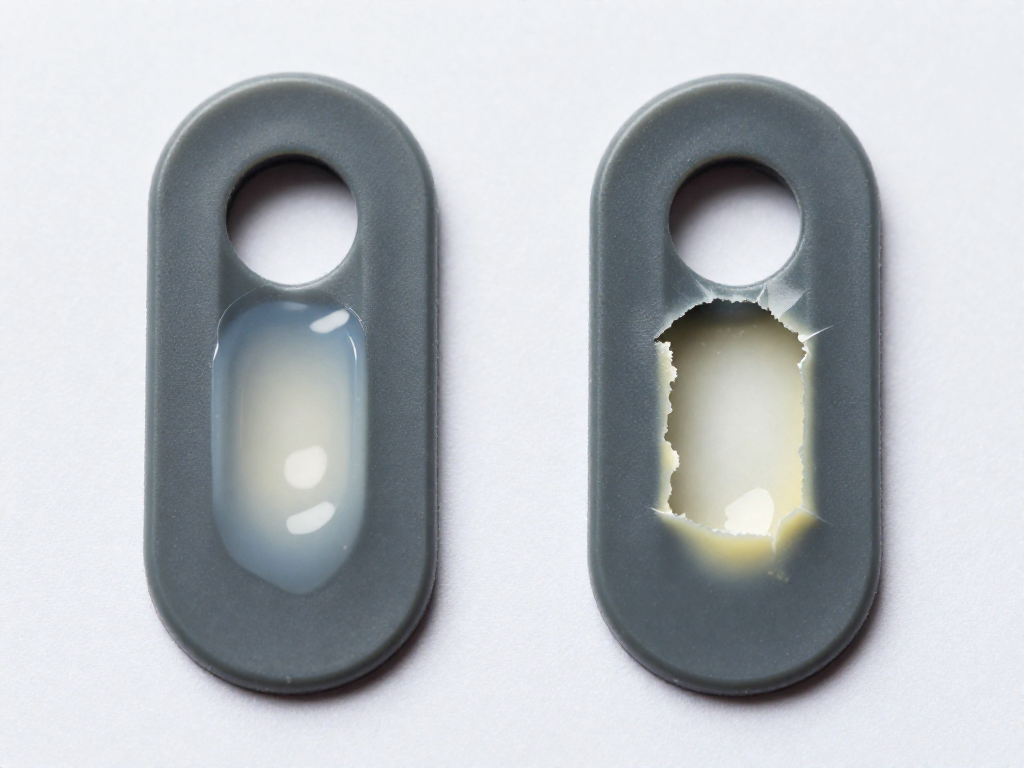
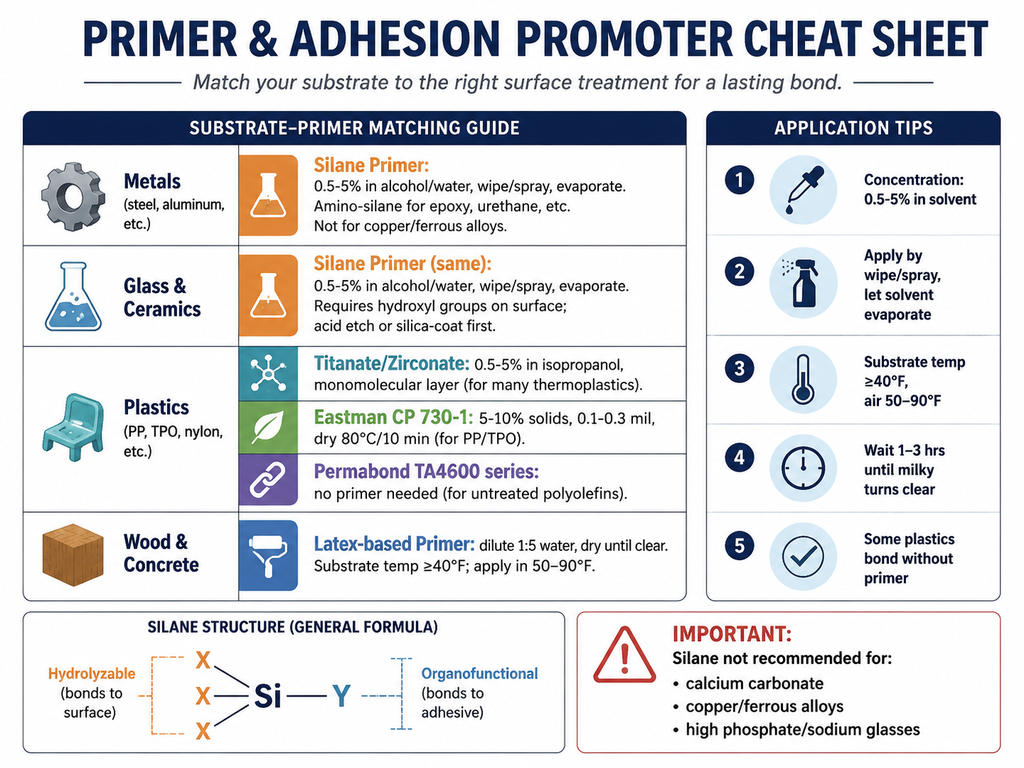
You clamped that epoxy repair on a plastic bracket, waited the full 24 hours, and then watched the entire glue bead peel off in one clean sheet—that’s not bad luck, it’s a surface energy mismatch that a primer would have fixed. Primers chemically bridge the gap between inert surfaces and your adhesive. For metals and glass, silane primers have a dual-ended structure that bonds the inorganic surface to organic coatings (ZMSilane); for low-energy plastics like polypropylene, titanate primers or chlorinated polyolefins (e.g., Eastman CP 730-1) are your best bet.
How Silane Coupling Agents Actually Stick: A Molecular Bridge
Think of a silane primer as a bifunctional molecule that speaks two languages fluently. On one end, it grabs hold of an inorganic surface. On the other, it reaches out and crosslinks with your adhesive or coating. The general structure is X₃SiY. The X groups are hydrolyzable—typically methoxy or ethoxy—and the Y is an organofunctional group selected to match whatever organic resin you plan to use.
First, water in the primer solution or adsorbed on the surface hydrolyzes those X groups, converting them into reactive silanol (Si-OH) groups. Those silanols then condense with hydroxyl groups on the substrate, locking the silane down with strong covalent bonds. Meanwhile, the Y group stays available to chemically link into the adhesive during cure. That’s the molecular bridge.
This chemistry only works if the substrate has accessible surface hydroxyls. Ideal candidates are silicate-type fillers, glass, and metal oxides or hydroxides—basically anything with an oxide layer that readily offers -OH groups. But not all materials are suitable. Do not use silane adhesion promoters on calcium carbonate, copper, ferrous alloys, or high-phosphate/sodium glasses (Gelest). These either lack the right hydroxyls (carbonates) or form unstable bonds that break down later. Dipodal silanes have pushed the envelope for ferrous and nonferrous metals, but standard formulations still struggle with those substrates.
Two practical perks: silane primers work at room temperature and generate negligible sludge, making them far cleaner and cheaper to run than legacy zinc phosphate or chromate treatments. For tricky applications, hybrid silane blends (like mixing bis-silanes with mono-silanes) bump up cross-link density for improved moisture resistance. Just remember that silanes aren’t a cure-all for wet environments. In dentistry, where silanes bond porcelain to resin, long-term water exposure still degrades the interface, which is why pre-etching or tribochemical silica coating is routine before silanization.
Applying a silane primer is delicate. They are typically supplied as a very dilute alcohol solution to control reactivity and keep shelf life manageable. A thin film is all you need; flooding the surface wastes material and can create a weak boundary layer.
Titanates and Specialty Promoters: When Plastics Refuse to Bond
Polypropylene and other polyolefins sit at a surface energy around 29 mN/m—so low that most adhesives bead up instead of flowing out. That’s where titanate coupling agents earn their keep. Unlike silanes, titanates react with any available surface hydroxyls but skip the condensation step; they leave a clean monomolecular layer instead of building a polymer network. You can dose them into the adhesive at 0.5–3% or wipe on a 0.5–5% isopropanol primer.
For automotive-grade durability on TPO and PP, Eastman CP 730-1 is the heavy hitter. Apply it as a primer at 5–10% solids to a 0.1–0.3 mil thickness (air-dry or 10 minutes at 80°C), and it stands up to gasoline and humidity that wreck ordinary bonds (Eastman Chemical).
But primer isn’t always mandatory. Structural acrylics like Permabond TA4605 series and Infinity Bond MMA 500 grab untreated polypropylene straight out of the tube—no flame, plasma, or wipe needed. If you’re working with silica, glass, or metal oxides, stick with silanes; their hydroxyl-rich chemistry is still the champion for inorganic surfaces. Titanates, on the other hand, were built for stubborn polyolefins.
The Step Everyone Skips: Surface Prep Before You Prime
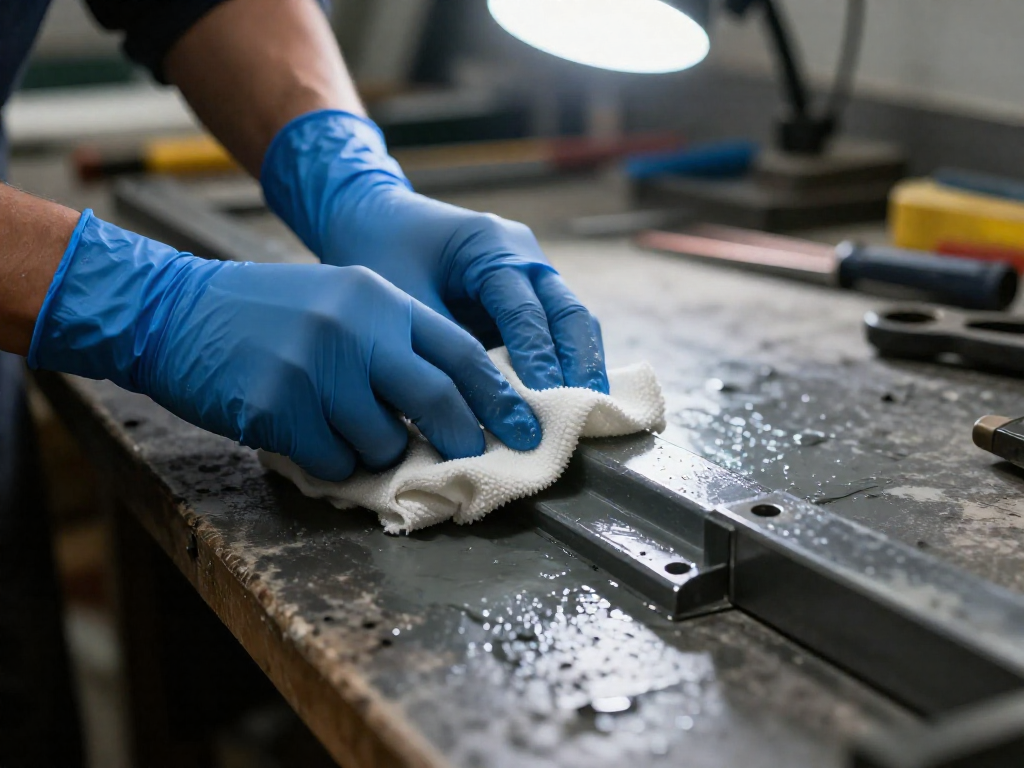
Primer is not a substitute for elbow grease. Even the most advanced silane or titanate coupling agent will underperform if the surface is oily, dusty, or slick. Before you reach for that bottle, the substrate must be meticulously clean, dry, and often microscopically rough. Contaminants act as a barrier—your primer needs direct contact to form a chemical or mechanical lock.
Surface prep varies wildly by material, but the goal is the same: expose a high-energy surface full of reactive sites. In dental bonding, porcelain is acid-etched to create hydroxyl groups, while metal alloys get a tribo-chemical silica coating before silanization (PubMed). For ceramic coatings on a car, the standard is a deep clean with 70% isopropyl alcohol and sometimes a clay bar to lift embedded fallout. When priming a porous tile substrate, manufacturers like Laticrete instruct you to dilute the first coat of primer 1:5 with water, then let it dry until clear—usually 1 to 3 hours. Skip that waiting window, and the bond may fail as the primer is sucked into the surface instead of staying where it can work.
For everyday DIY repairs on metal or plastic, you rarely need extreme steps. A simple wipe with isopropyl alcohol and a quick scuff with 220-grit sandpaper can transform a bond. Just be sure the surface is fully dry and within the primer’s working temperature range—most products need a substrate temperature of at least 40°F and ambient air between 50°F and 90°F for proper curing. The takeaway: the best primer won’t stick to a dirty, passive surface. Make it clean, make it rough, and you’ll rarely need a second try.
Nailing the Application: Concentration, Coverage, and Cure
Most primers are thin solutions designed for a wipe or spray coat—not a heavy brush-on layer. Silane primers are typically just 0.5–5% active ingredient in alcohol or water; you’re laying down a molecular bridge, not a filler. For stubborn plastics, Eastman CP 730-1 works as a 5–10% solids primer applied at a mere 0.1–0.3 mil thickness—air dry or bake at 80°C for 10 minutes (Eastman).
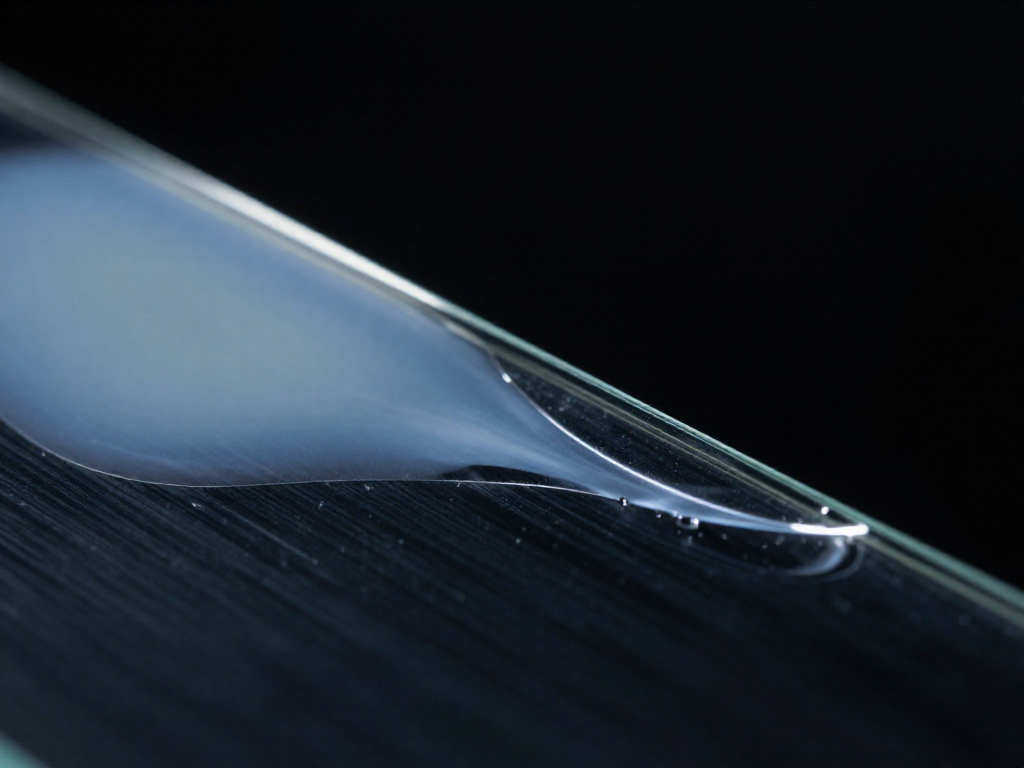
The golden rule: one thin, even coat. Puddling or double-coating traps solvent and causes bond failure. Wait for the primer to flash off. Some, like Laticrete Primer Plus, signal dryness by turning from milky white to clear; expect 1–3 hours at room temp, though 24 hours might be needed for full chemical cure of the final adhesive. Keep the substrate above 40°F (4°C) and air between 50–90°F—cold surfaces slow evaporation and leave a dormant film.
Skip the Bottle: When a Primer Is a Waste of Time (or Makes Things Worse)
Primer isn’t an automatic step — sometimes it’s a waste of time, and on certain substrates it can actually undermine adhesion. Silane coupling agents, for example, are not recommended on ferrous alloys, copper, calcium carbonate, or high-phosphate/sodium glasses. For polyolefins like PP and PE, you can often skip the whole pre-treatment ritual: Permabond TA4610 and similar acrylic adhesives are formulated to bond untreated surfaces directly (CBRHK). When working with metals, properly abraded steel or aluminum and a reactive adhesive (MMA or epoxy) rarely need a primer — just clean and rough up the surface. If you’re bonding plastics, a quick flame treatment or corona discharge can replace a liquid primer entirely. The real rule of thumb: if the surface is clean, micro-rough, and the adhesive wets out completely, you’re probably fine without a primer. Always check the adhesive manufacturer’s datasheet — if they don’t ask for one, don’t add it.
The 60-Second Cheat Sheet for Primers That Actually Hold
Match the chemistry: silane primers for glass, ceramics, and many metals (skip them on copper or ferrous alloys without a specialist grade). Titanates unlock low-energy plastics. Clean first—no primer sticks to grease. Apply thin; a 0.1–0.3 mil coat from a 5–10% solids solution is typical (Eastman), then let it dry completely before adhesive. If you're unsure, test on a hidden spot. Think of primer as a chemical bridge, not a glue substitute—it handshakes the surface so your adhesive can do its job.
Sources
- Development of Silane-Based Primers for Metal Surfaces — zmsilane.com
- Silane – A Multifunctional Compound for Plastics — specialchem.com
- Silane Coupling Agents — gelest.com
- Silane adhesion mechanism in dental applications and surface treatments: A review - PubMed — pubmed.ncbi.nlm.nih.gov
- A Guide to Silane Solutions: Adhesives and Sealants — azom.com
- How to Apply - Titanium Ceramic Coatings — titaniumceramiccoatings.com
- TDS 230 — cdn-global.laticrete.com
- SURFACE PREPARATION GUIDELINES Ceramic Tile and ... — proma.us
- Sprayed Titanium Coatings on Metal, Ceramics & PEEK — dot-coating.de
- Adhesion Promoters: Adhesion Basics & Material Selection Tips for ... — specialchem.com
- Polypropylene Adhesive Compatibility: Your Complete Bonding Guide - CBRHK — cbrhkglobal.com
- Solventborne adhesion promoters for difficult-to-adhere-to ... — eastman.com
See also
- best-adhesive-for-plastic-to-metal
- surface-preparation-for-bonding
- understanding-adhesive-types-epoxy-vs-cyanoacrylate
- tensile-strength-and-joint-design
Related articles
Common Surface Prep Mistakes That Ruin Adhesion: Troubleshooting Guide
Why did my glue not stick even though I did everything right?
Jul 22, 2026 · 8 min read
Clamping and Curing: Proper Pressure and Time for Different Adhesives
How much clamping pressure and time do I need for my glue to cure properly?
Jul 22, 2026 · 5 min read
Joint Design for Strong Bonds: Butt, Lap, Scarf, and More
How does the shape of the joint affect glue strength?
Jul 22, 2026 · 12 min read