Deck Screws vs. Nails: Fastening Deck Boards for Longevity
Should I use screws or nails for my deck, and what type?
On this page
The screws-vs-nails debate isn’t as simple as ‘screws hold better.’ Ring‐shank nails can rival screws in pull‐out resistance, yet wet conditions and wood movement flip the script. This guide uses real test data to show you what actually determines a deck’s lifespan—and where hidden fasteners fit.
Introduction: Beyond the ‘Screws Are Better’ Myth
Screws aren't automatically the better choice for deck boards. Real longevity hinges on how fasteners handle moisture-driven movement and fatigue, not just initial pull-out strength. Screws boast superior withdrawal resistance, but ring-shank nails now close that gap—the APA – The Engineered Wood Association rates their withdrawal at an equivalent specific gravity of 0.70 versus just 0.40 for plain shank nails. Nails, however, bring an elasticity that screws can't match. They bend and give as wood swells, where brittle screws can snap or loosen under repeated cycles. That give also lets nails pull down warped boards tightly. The question isn't which holds harder; it's which holds smarter over time.
Withdrawal Resistance: The Science Behind Holding Power
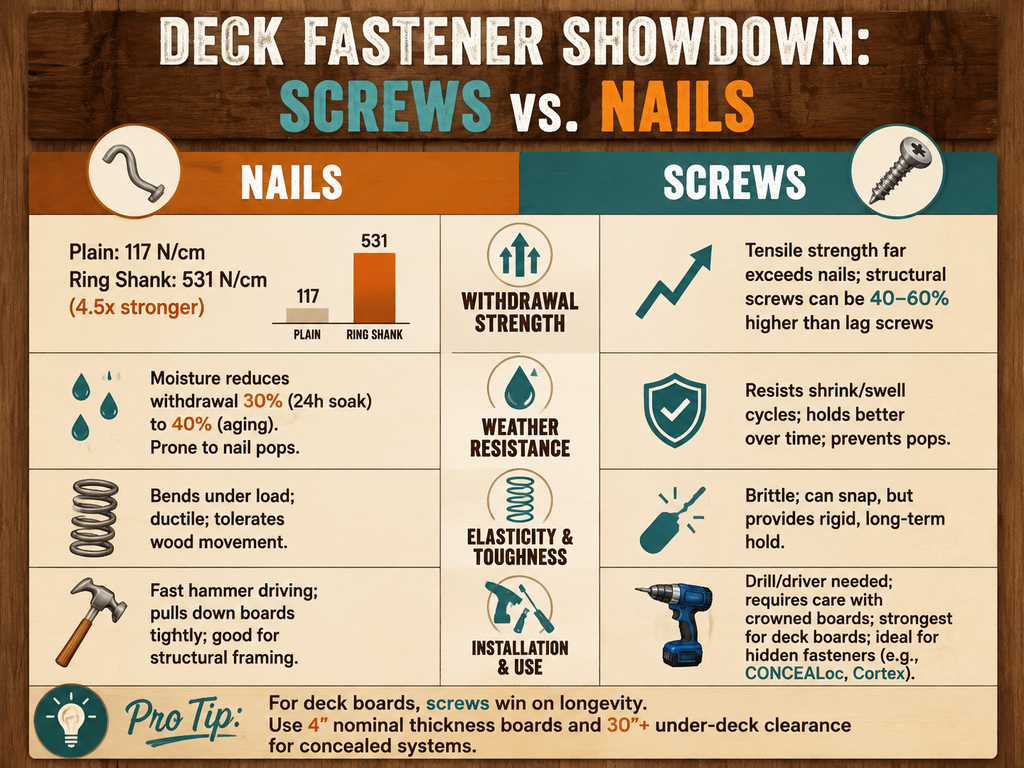
Withdrawal resistance—how hard you have to pull to yank a fastener straight out—is the hidden performance number that separates a deck that stays flat from one that pops boards every spring. For nails, the shank design makes a staggering difference. In dry 9.5 mm plywood, plain shank nails muster just 117 N/cm of withdrawal resistance. Ring shank nails of the same diameter? 531 N/cm—a more-than-fourfold grip increase (APA). That’s why a smooth nail used on decking is almost always a mistake; ring shanks dig in and resist the steady tug of warping wood.
But even ring shanks lose ground when moisture enters the picture. For wet-service conditions, the industry applies a 0.75 adjustment factor to allowable withdrawal strength—a 25% reduction right off the bat. And when the wood cycles through repeated wetting and drying, the decay accelerates. After a 6-cycle accelerated aging test, the average nail withdrawal resistance had fallen by roughly 40%. That’s the reality of an exterior deck: nails start strong but degrade steadily, especially in ground-contact framing or damp climates.
Screws attack the problem from a different angle. A modern self-tapping structural screw with hardened, aggressive threads can deliver 40–60% more withdrawal capacity than a traditional lag screw of similar diameter in softwoods. Instead of relying on friction and wood spring-back, the screw threads carve a mechanical lock into the fibers, making it far harder for the wood to heave the fastener out. Builders consistently find that screws resist the cyclical shrink/swell pumping that slowly jacks nails loose, keeping deck boards snug for years instead of months.
Two other variables tip the scales further. Wood density is a major player: dense larch (around 35 lb/ft³) regularly outperforms spruce (around 28 lb/ft³) for the same screw embedment, so what you’re screwing into matters almost as much as the screw itself. And grain direction demands respect. Screws driven into end grain only achieve about three-quarters of the withdrawal strength they’d reach in side grain. When laying deck boards, side-grain fastening is the rule—screw into the face, not the butt end, or you’re sacrificing a quarter of your holding power.
For a deck that will see rain, sun, snow, and bare feet for decades, withdrawal resistance isn’t a textbook number—it’s the difference between a solid surface and a squeaky, lifted board.
Structural Dynamics: Shear, Tensile Strength, and Elasticity
The knee-jerk fear is shear failure—boards scissoring off fasteners under load—but on a deck, direct shear across the board-to-joist connection is rare. And when it comes to pure shear strength, the difference between nails and screws isn’t dramatic. Engineers report minimal gap in shear capacity between the two, especially with quality fasteners. The real performance divider is something else entirely: ductility.
Standard deck screws are hardened and brittle. Drive one partway and give it a sharp hammer blow—it will snap clean off. A nail, hit the same way, simply bends (Home Improvement Stack Exchange). That bendability matters more than you’d think. Deck boards expand, contract, and flex under foot traffic. A nail yields with the wood, maintaining its grip while absorbing movement. A stiff screw, on the other hand, can’t give at all. Instead, it concentrates stress on the surrounding fibers, gradually crushing them. Over time, this micro-destruction widens the hole, and the screw’s hold loosens long before it would actually pull out. In fact, some pros argue screws cause faster board wear precisely because they destroy wood around the shank before backing out.
While nails also work loose through shrink‑swell cycles, their inherent elasticity makes them more forgiving under dynamic live loads. Screws may dominate in pure withdrawal resistance, but for a deck surface hammered by shifting forces, nails provide a durable “elastic connection” that brittle screws can’t match. That’s why shear strength rarely settles the argument.
Installation Hurdles: Pull-Down, Popping, and Board Damage
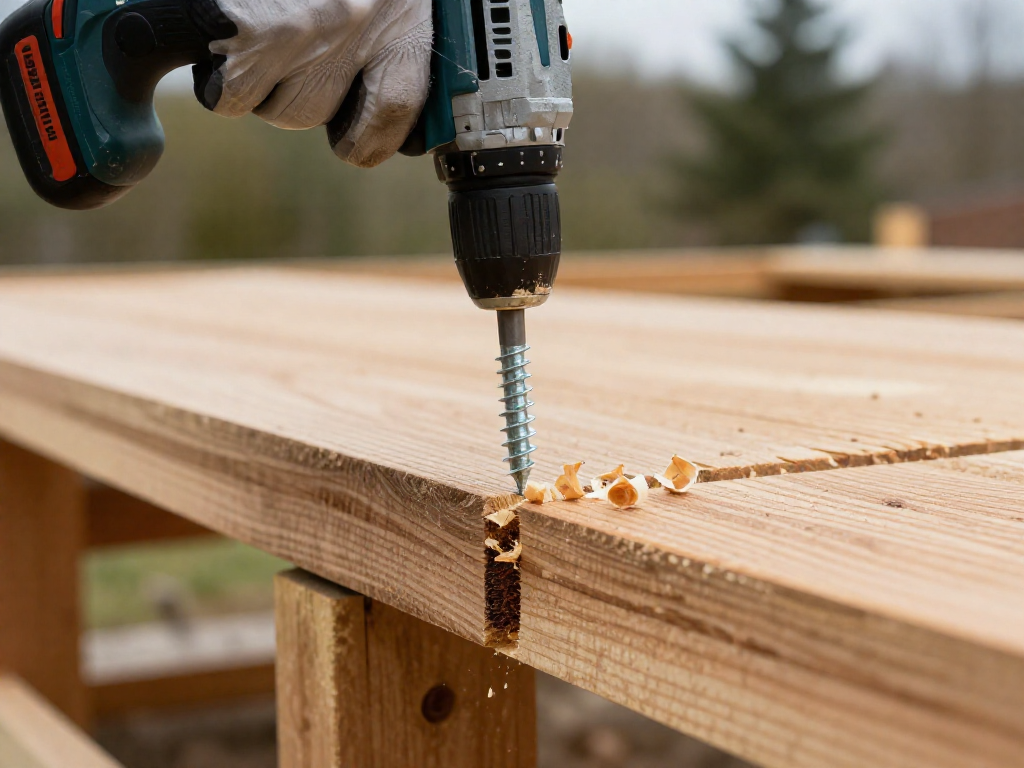
Screws may win on long‑term holding power, but they come with a frustrating installation catch: they often can’t cinch down a twisted or crowned board as tightly as a nail. If you’re fighting a stubborn board that wants to spring up, a screw will just spin once the head bottoms out—leaving a gap you can’t close (Home Improvement Stack Exchange). In those situations, you may need a clamp or a temporary nail to pull the board flush before driving the final screw.
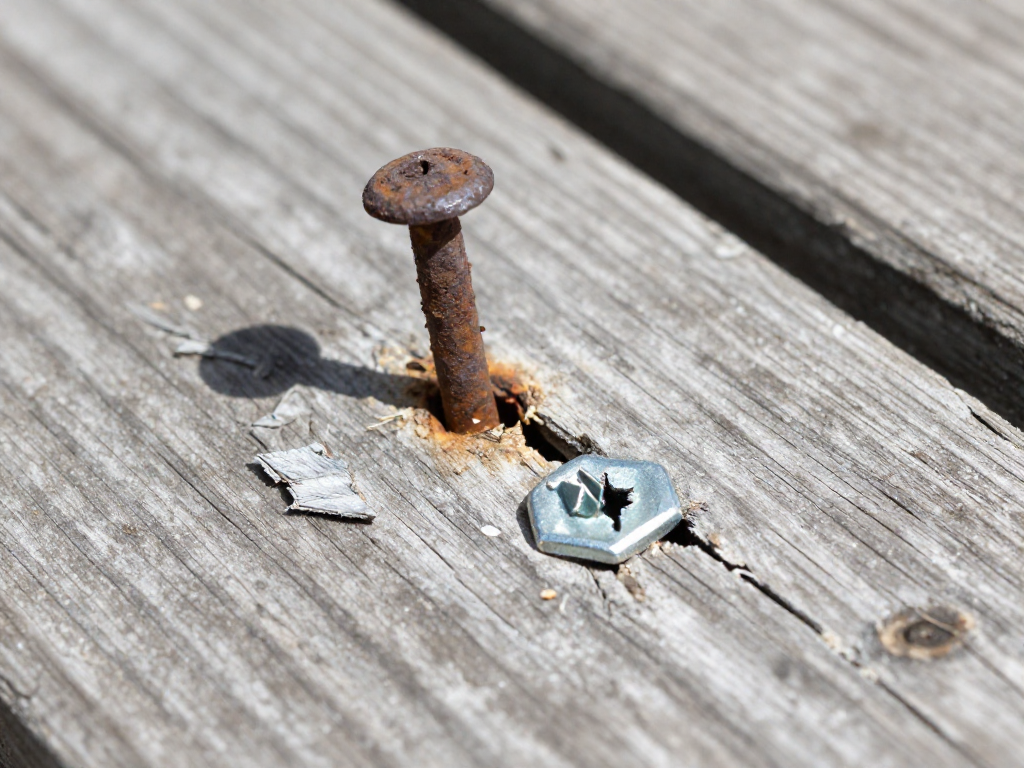
Nails have the opposite problem over time. Shrink/swell cycles as wood alternately dries and gets wet literally work them up and out of their holes. You end up with ugly, hazardous nail pops that demand hammering back down season after season. Screws, with their threads actively gripping wood fibers, resist this ratcheting effect much better.
There’s another lever you can pull: board width. Narrower decking (4″ nominal) requires about 50% more fasteners per square foot, which locks everything down more tightly and reduces the movement that leads to pops and board damage. It’s a simple change that makes the whole assembly sturdier, especially in climates with wild moisture swings.
Hidden Fasteners: Aesthetic Appeal vs. Practical Limits
That clean, fastener‑free deck surface comes at a cost. Hidden systems like TimberTech’s CONCEALoc and Cortex plugs deliver a sleek look—CONCEALoc clips into factory‑grooved boards, while Cortex drives a specialty screw you cap with a matching plug. But if you’re chasing maximum holding power, face‑screwing directly into joists still wins. Mataverde puts it plainly: screwing through the face is the strongest method, period.
These concealed systems also demand more from your deck’s structure. You need at least 30 inches of ground clearance and ventilation on three sides to keep the hidden clips and the underside of the boards dry. Without that airflow, trapped moisture can degrade both fasteners and framing. And you can’t just grab any composite board—CONCEALoc only works with TimberTech’s grooved profiles; other hidden systems have their own matching grooves. Mixing brands or trying to retrofit smooth boards is a sure way to void the warranty.
Sticking with the manufacturer’s specified fasteners isn’t just a suggestion—it’s mandatory for composite deck warranty coverage. TimberTech’s own guidance is unambiguous: use their fasteners with their boards, or risk losing your protection. If your deck is low to the ground or you’re working with tricky crowned boards, skip the hidden route. For wide‑open, well‑ventilated decks where you’re willing to trade a bit of ultimate strength for a spotless surface, these systems earn their keep.
Making the Right Choice for Your Deck’s Longevity
If you’re building in a wet climate where withdrawal resistance is the top priority, coated ring-shank nails deliver the grip—testing by APA - The Engineered Wood Association shows a withdrawal-specific gravity of 0.70 for ring-shank nails versus just 0.40 for plain shank, meaning they hang on far tighter as wood swells and shrinks. Structural screws driven into side grain are a second strong choice; just avoid end grain where withdrawal capacity drops to about three-quarters.
Where board wear and replaceability matter more, nails’ elasticity can actually prolong the life of deck boards by allowing the wood to move without tearing out fibers—screws, in contrast, hold so rigidly they risk destroying wood fibers before backing out.
For composite decking, hidden fasteners give a clean, fastener-free surface, but you must use the brand’s proprietary system; TimberTech fasteners are uniquely designed for their boards and required for warranty coverage. If you’re ever uncertain, drive a few fasteners into a scrap piece and test the pull-out resistance yourself.
Sources
- Nail Withdrawal and Pull-Through Strength of Structural-Use Panels — apawood.org
- Screw Pull-out Strength: Pine vs. Hardwood Comparison | Senmit — senmit.com
- Is there a case where nails are better than screws, from an engineering/structural standpoint? - Home Improvement Stack Exchange — diy.stackexchange.com
- Direct withdrawal and head pull-through performance of nails and staples in structural wood-based panel materials — fpl.fs.usda.gov
- Standard Field Test Procedure for Determining the Withdrawal Resistance of Roofing Fasteners — spri.org
- Rebuilding an exterior deck is it better to use screws or nails? - Home Improvement Stack Exchange — diy.stackexchange.com
- Deck Fasteners, Steel Deck Screws, & More | TimberTech — timbertech.com
- When To Use Concealed Deck Fasteners: A Contractor's Guide — mataverdedecking.com
See also
- /composite-decking-fastener-guide
- /best-hidden-fastener-systems
- /pressure-treated-lumber-fastener-compatibility
- /how-to-choose-deck-screws
Related articles
Machine Screws, Bolts, and Nuts: A DIYer’s Guide to Size and Grade
How do I know what size bolt and grade to use for a mechanical repair?
Jul 22, 2026 · 3 min read
Toggle Bolts: The Strongest Drywall Anchor? When to Use Them and How to Install
How do I install toggle bolts for heavy wall-mounted items?
Jul 22, 2026 · 5 min read
How to Choose Screws for Outdoor Use: Galvanized, Stainless, or Coated?
Which screw finish prevents rust best for outdoor projects?
Jul 22, 2026 · 3 min read