How to Choose Screws for Outdoor Use: Galvanized, Stainless, or Coated?
Which screw finish prevents rust best for outdoor projects?
On this page
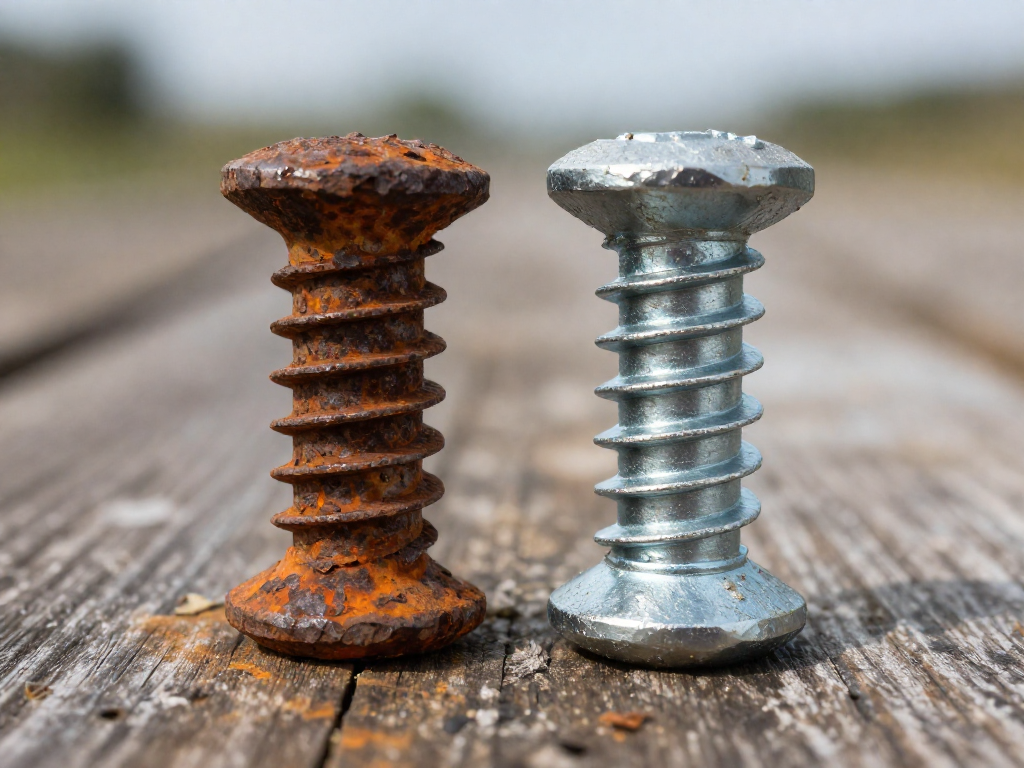
You finish a weekend deck build, only to find the screws bleeding rust a few months later—the wrong finish turned a solid project into an eyesore. Choosing the right outdoor screw isn't about ‘best glue’ lists; it’s about matching a metal’s corrosion resistance to real exposure: rain, salt, UV, and pressure-treated lumber. We compare zinc-plated, hot-dip galvanized, stainless steel, and ceramic-coated screws so you can pick the one that holds—literally.
The Real Enemy: What Outdoor Conditions Do to Screws
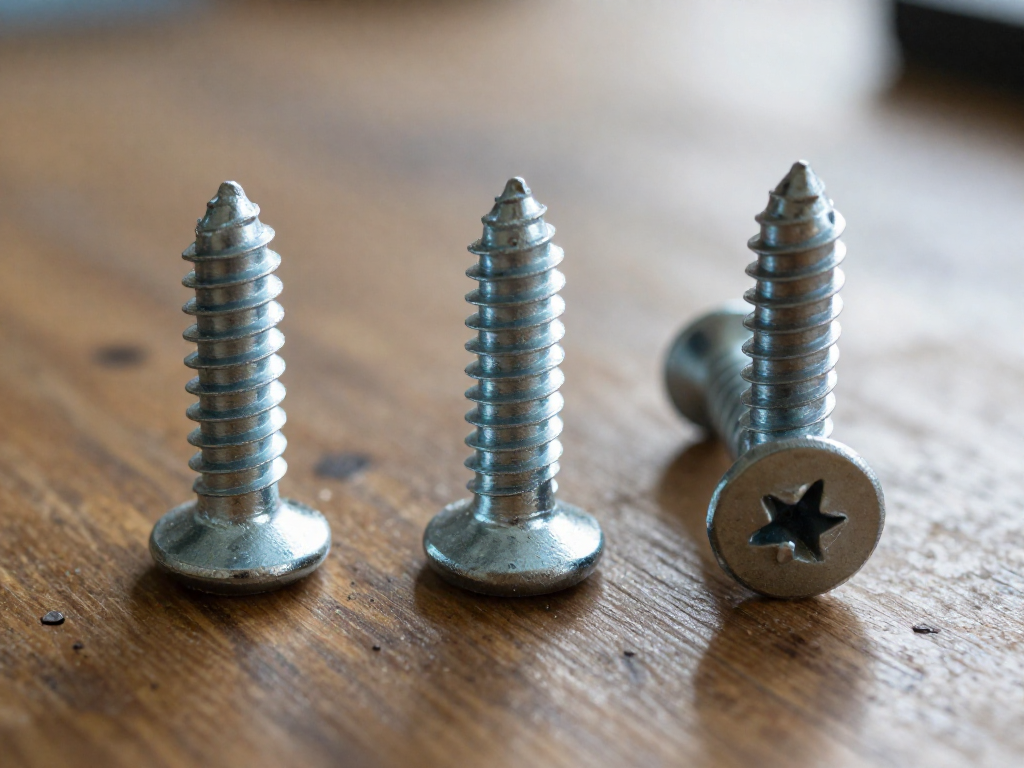
Stainless steel screws are the only truly rust-proof choice outdoors—use 316 in coastal areas, 304/305 elsewhere. That’s because moisture, salt, and the copper in pressure-treated lumber relentlessly attack metal. Coatings either block these elements or sacrifice themselves: zinc, for example, corrodes about 30 times slower than the steel it shields (SFS USA).
Galvanized: Hot-Dip vs. Zinc-Plated – It’s All About Thickness
If you think “galvanized” is a one-size-fits-all shield against rust, it’s time to look closer. The difference between zinc-plated and hot-dip galvanized screws is thickness—and that thickness dictates whether your deck holds for decades or saddles you with rusty replacements in a season.
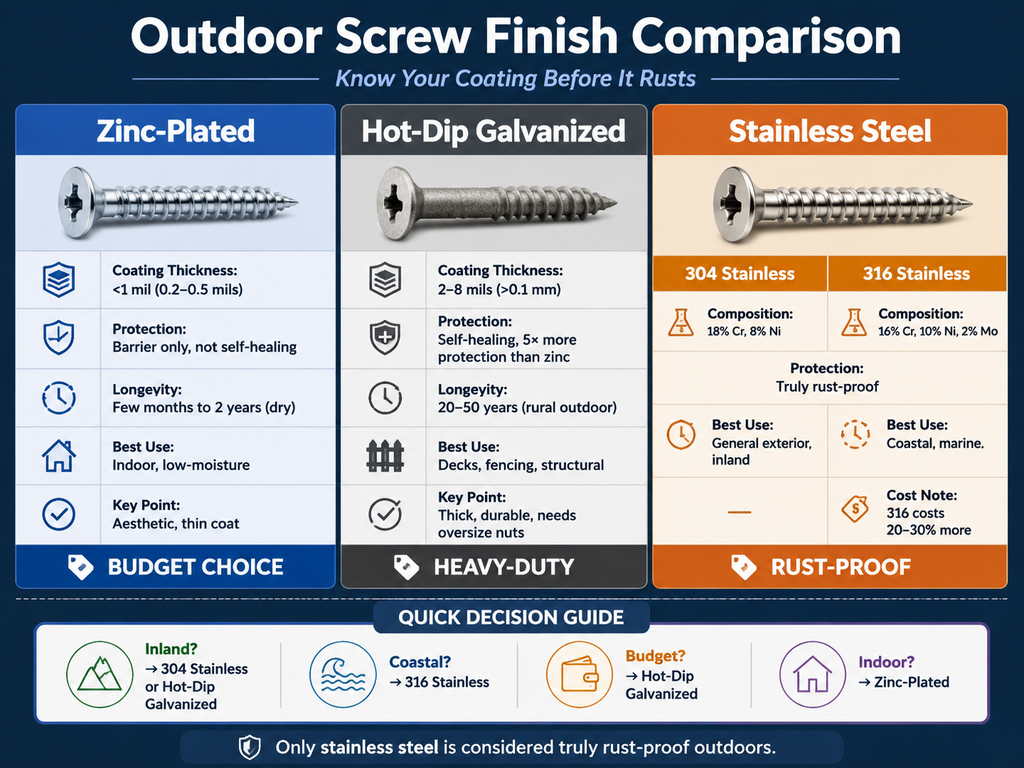
Zinc plating is a thin, mostly cosmetic layer, generally between 0.2 and 1 mil thick (0.005–0.025 mm). It gives a bright, shiny finish and keeps a screw rust-free indoors, but outside, it’s a countdown to brown crust. In a rural outdoor setting, hot-dip galvanized fasteners can endure 20 to 50 years while zinc-plated screws might start rusting in months (Bonan Tech). That’s because hot-dip galvanizing creates a thick, bonded coating—typically 2 to 8 mils—that provides roughly five times more protection from the elements.
That thick coating has a trick up its sleeve: when scratched, the surrounding zinc sacrifices itself to protect the exposed steel, a self-healing property you won’t get from thin zinc plate. Zinc corrodes about 30 times slower than steel, so even scratches stay sealed. One trade-off: that extra girth means standard nuts won’t fit. Hot-dipped nuts are tapped oversize to accommodate the coating, so you must use matched sets.
Yes, hot-dip screws cost more, ounce for ounce. But given they last decades instead of months, the math is simple: replace rusted fasteners once, and you’ve already spent more on labor and materials than the initial price difference.
Stainless Steel: Why 304 Often Isn’t Enough Outdoors
Stainless steel is the only screw finish that can honestly claim to be rust-proof outdoors—but that’s only true if you pick the right grade for your environment. Type 304 (often labeled 18/8) is the workhorse for general exterior projects well away from salt. It packs 18% chromium and 8% nickel, which forms a passive oxide layer that resists corrosion in rain and humidity. However, 304 is vulnerable to chloride pitting. If you live near a coast or anywhere that gets road salt, that invisible chloride exposure will cause tea staining and eventually pitting, degrading the fastener long before the project fails.
That’s where 316 steps in. It contains 16% chromium, 10% nickel, and crucially 2% molybdenum (Portland Bolt). That molybdenum gives 316 its legendary resistance to saltwater corrosion, making it the only safe choice for docks, beachfront decks, and any marine exposure. You’ll pay roughly 20–30% more for 316, but that premium is trivial compared to replacing rusted-out hardware in a salt-lashed structure. For inland builds, 304 is fine, but if you can smell the sea, skip the 304 and go straight to 316.
Ceramic & Other Coatings: Decent, but Not Rust-Proof
Ceramic-coated screws are a solid middle ground for outdoor projects. They’re corrosion-resistant, not rust-proof, and best for decks, fencing, exterior wood, and pressure-treated lumber (The Fastener Depot). They cost less than stainless, but under constant moisture or coastal salt, the coating will eventually fail and rust will start. Other organic and polymer coatings offer similar trade-offs: better than bare or zinc-plated, but nowhere near stainless-grade protection. Think of them as sacrificial layers that buy you time.
Quick-Reference: Which Screw for Your Project?
Match the screw to the exposure. For indoor or dry spots, basic zinc-plated is enough. Under eaves or sheds, step up to hot-dip galvanized or 304 stainless. Decks and fences need the same inland, but switch to 316 stainless within a few miles of salt water. Pressure-treated lumber demands hot-dip galvanized or ceramic-coated screws—304 and 316 also handle it. Salt air or submersion? Only 316 stainless is truly rust-proof in those conditions, as The Fastener Depot confirms.
Sources
- Zinc Plated vs Hot Dipped Galvanized Screws - Lilly Fasteners — kglilly.com
- Coatings & Finishes: The Differences Between Hot Dip Galvanising And Zinc Plating - Accu Inc — accu-components.com
- Screws With Zinc FAQ About Rust + More | SFS USA — us.sfs.com
- Hot-Dipped Galvanizing or Zinc Plating: Which is Better? — southatlanticllc.com
- Hot-Dip Galvanizing vs Zinc Plating - Portland Bolt — portlandbolt.com
- Type 304 vs. Type 316 Stainless Steel - Portland Bolt — portlandbolt.com
- 304 vs 316 Stainless Steel: When to spend extra on marine grade? — reddit.com
- The Complete Guide To Rust-Proof Screws & Fastener Coatings — thefastenerdepot.com
- News - Is Galvanizing Screws and Nuts Worth It — bonantechltd.com
See also
- Galvanic Corrosion: What Happens When You Mix Metals
- Understanding Thread Types: When to Use Coarse vs. Fine Screws
- How to Prevent Screws from Stripping in Hardwoods
Related articles
Machine Screws, Bolts, and Nuts: A DIYer’s Guide to Size and Grade
How do I know what size bolt and grade to use for a mechanical repair?
Jul 22, 2026 · 3 min read
Deck Screws vs. Nails: Fastening Deck Boards for Longevity
Should I use screws or nails for my deck, and what type?
Jul 22, 2026 · 6 min read
Toggle Bolts: The Strongest Drywall Anchor? When to Use Them and How to Install
How do I install toggle bolts for heavy wall-mounted items?
Jul 22, 2026 · 5 min read