DIY Car Repair Adhesives: Fixing Trim, Lights, and Panels That Last
What adhesives work best for automotive exterior repairs?
On this page
Most DIYers grab whatever glue is in the garage, then wonder why their trim piece flew off on the highway. The right automotive adhesive isn't just about stickiness—it's about surviving heat, vibration, and road spray. Here's how to choose between double‑sided tape, urethane, and epoxy using lab‑proven strength data so your repair actually stays put.
Why Automotive Adhesives Beat Mechanical Fasteners
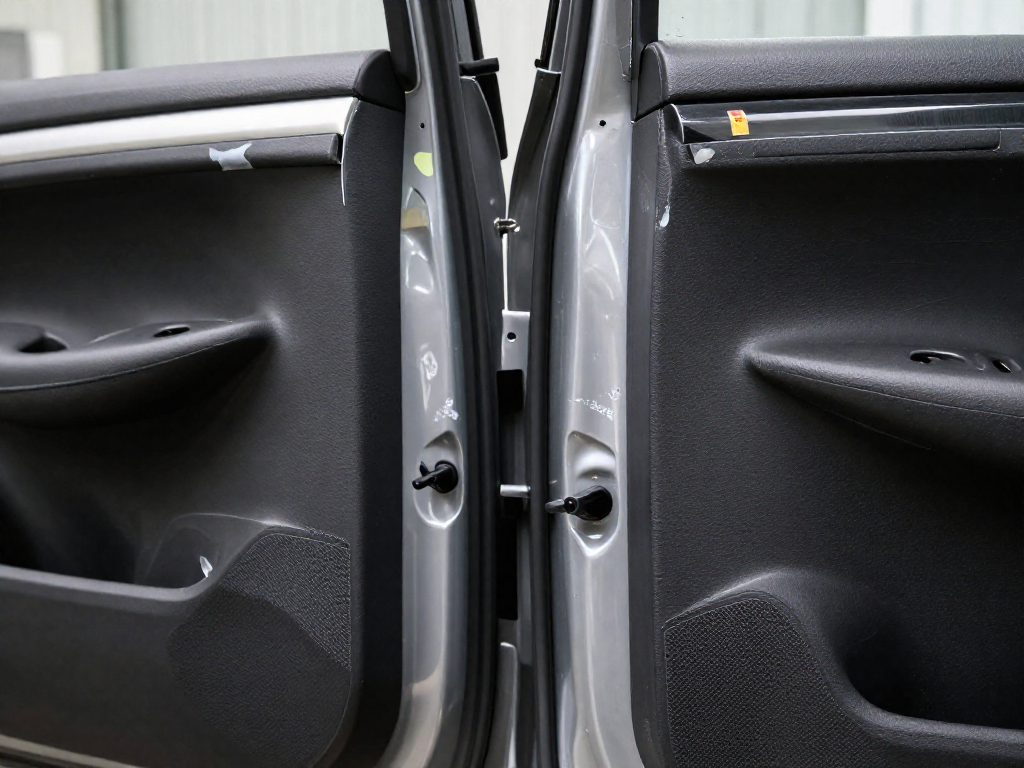
When reattaching a loose body panel or exterior trim, skip the drill — modern automotive adhesives like two-part polyurethanes and high-strength acrylic tapes often hold better than screws or clips. They seal out moisture, so there’s no drilled hole to start rust. Because the bond spreads stress across a wide area, you get fewer stress cracks around the fastener. Polyurethane adhesives, for example, stay flexible and absorb road vibration without loosening, which is why OEMs use them to bond bumper covers and side panels (Polytontech). A roll of structural tape also mounts trim in minutes with no measuring or hardware. For anything safety-critical like suspension or seatbelt anchors, though, mechanical fasteners still have the final word.
Double-Sided Tape: The Secret Weapon for Trim and Emblems
If you’ve been dismissing double-sided tape as a quick-fix for badges and trim, it’s time to reconsider. The right tape — specifically, 3M VHB (Very High Bond) — is a legitimate structural adhesive that automakers rely on for spoilers, side skirts, and exterior emblems that stay put at highway speeds and through car washes. It isn’t the thin foam strip from the stationery aisle; it’s a thick acrylic foam core that acts like a shock absorber, soaking up vibration and the constant push-pull of thermal expansion between dissimilar materials.
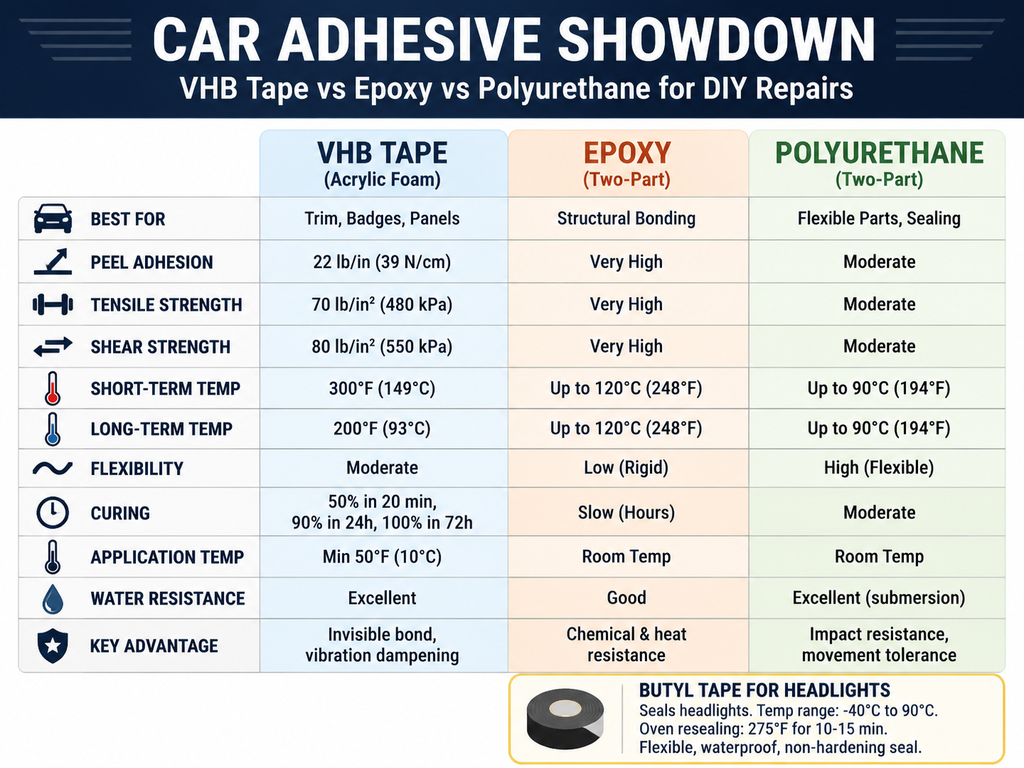
At room temperature, VHB tapes deliver a dynamic overlap shear strength of 80–100 psi, and 90° peel adhesion can reach up to 22 lb/in. Those numbers translate to real holding power: once cured, a properly applied emblem withstands the force of wind, road bumps, and routine handling without budging. The acrylic chemistry also handles heat better than you’d expect — continuous service up to 250°F (121°C) with short-term spikes to 300°F (149°C). For a spoiler baking under the summer sun, that margin matters.
Choosing the right tape for your substrate is where most DIY jobs go wrong. High-surface-energy plastics, bare metal, or glass call for the 3M VHB 4941 family, which offers excellent plasticizer resistance, critical for vinyl trim and painted metals that can leach softening agents over time. For low-surface-energy substrates — think powder-coated bumpers, textured plastics, or factory paints that feel slick — reach for 5952. Its modified acrylic adhesive conforms beautifully and sticks where lesser tapes simply peel away. Truly stubborn materials like polyethylene or polypropylene demand the LSE (Low Surface Energy) family; same core, stickier face.
Application is simple but unforgiving if you rush. Start with a thorough wipedown using 70% isopropyl alcohol and water; any trace of wax or silicone will kill adhesion. Press the tape into place with firm, even pressure — about 15 psi, 3M specifies — and keep the surface temperature above 50°F (10°C). Full cure takes 72 hours at room temperature, so resist the urge to yank on the part that same afternoon.
One common worry is water, and here the data is reassuring. In submerged conditions, a VHB bond can see a temporary drop in peak force — roughly 40% — but it’s fully reversible upon drying. That explains why your taped-on trim survives the pressure-washer: the strength returns once the bond dries. Outdoor durability is exceptional too: in 10-year exposure trials across Arizona and Florida, VHB tapes retained over 90% of their initial peel strength with no visible breakdown (Engineered Materials Inc.). For a DIY repair you want to last the life of the car, that’s a track record worth betting on.
Next time you reach for a mechanical fastener or a messy liquid adhesive, consider VHB tape. It’s faster to install, distributes stress more evenly, and leaves no holes — exactly what you want when mounting a set of side skirts or that irreplaceable vintage emblem.
Liquid Adhesives: When You Need Epoxy vs. Polyurethane
Epoxy and polyurethane are the two most common structural liquid adhesives for serious automotive repairs, but they could hardly be more different. Pick the wrong one and your bumper cover will crack, your spoiler will sag, or your weather seal will fail.
At the property level, it's a trade-off. Epoxy delivers very high strength and a rigid bond that resists creep under sustained loads—ideal for metal brackets, spoiler mounts, and anything where any movement means trouble. It also offers excellent chemical resistance, so it won't degrade in contact with fuel, oil, or coolant. Polyurethane, on the other hand, trades some ultimate strength for high flexibility and impact resistance. It absorbs vibration instead of transmitting it, making it the go-to for flexible plastic panels like bumper covers and side body panels that constantly flex. In a head-to-head breakdown, epoxy outmuscles polyurethane on strength and chemical resistance, while polyurethane wins on flexibility and impact absorption (Polytontech).
The cure speed matters too. Polyurethane adhesives typically have a faster open time and reach handling strength quicker—handy when you're working outside and don't want the car on jack stands for a full day. Epoxy cures more slowly, but that can be an advantage if you need to reposition parts before the bond locks.
Then there's moisture. If the bond could see standing water—think underbody panels or a leaky trunk seal—polyurethane has an edge. It's often considered the "go to" choice for submersion in water because epoxies can lose strength after long-term humidity exposure. Heat tells the opposite story: epoxy handles high temperatures much better, so near the exhaust or engine bay, epoxy stays solid while polyurethane softens.
The classic novice mistake is using epoxy on a flexible bumper cover. That brittle bond will crack the first time someone leans on the panel. Save epoxy for rigid, high-load metal assemblies. Conversely, don't trust polyurethane to hold a heavy spoiler or bracket at highway speeds—its lower static strength and creep tendency could lead to sagging over time.
Whatever you choose, surface prep is non-negotiable. Sand to bare plastic or metal, wipe with isopropyl alcohol, and keep everything free of oil. For extreme heat applications, look for an epoxy specifically rated for high temperatures; standard room-temperature-cure formulas can soften under sustained engine-bay heat. When in doubt, match the bond's stiffness to the part's expected movement: rigid with rigid, flexible with flexible.
Sealing Headlights with Butyl Tape
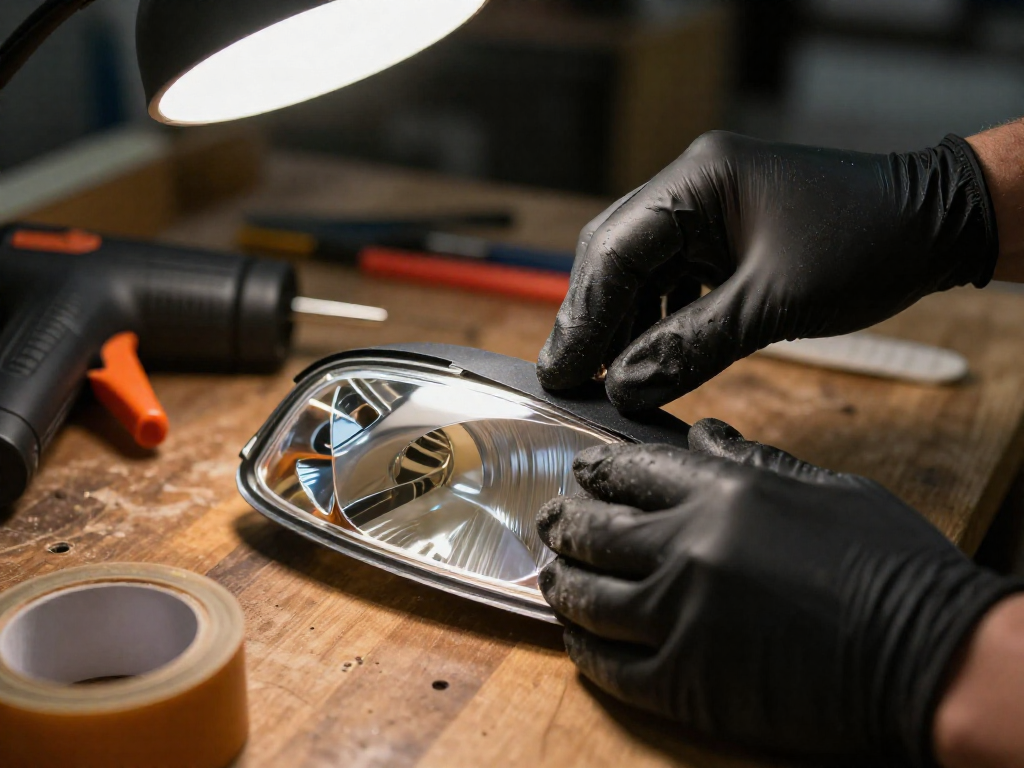
Car headlight seals fail gradually, but the fix is simpler than most people think. Skip the silicone—it hardens, cracks, and invites moisture back in. The right material is butyl tape, a non-hardening, permanently flexible sealant that shrugs off temperature swings from -40°C to 90°C without leaking. Some heavy-duty automotive butyl tapes even handle short 100°C spikes without flowing, so you won’t find gooey residue dripping inside the housing (QKD Tape).
Grab a roll of 2 mm × 20 mm butyl tape. A 5-meter roll covers two typical headlights with a few feet to spare. The Diode Dynamics 7 mm butyl rope is another popular choice, and one 20-foot roll is enough for a pair of large headlamps.
Set your oven to 275°F and warm the tape on a baking sheet for 10–15 minutes until it’s pliable but not runny. Work while the tape is soft: press it evenly into the housing groove, then fit the lens firmly into place. For the best initial tack, the adhesive and surfaces should be around 25°C—a garage-temperature day, not a chilly morning. Once assembled, that butyl bead stays flexible and waterproof for years, outlasting any silicone seal job.
Surface Prep and Application Tips for Weatherproof Bonds
Start by cleaning both surfaces with a 70% isopropyl alcohol / 30% water mixture, a step 3M strongly recommends for their automotive tapes. Ideal application temperature is 70–100°F (21–38°C); never bond below 50°F (10°C). Press the parts together with firm, even pressure—about 15 psi across the bond area. Allow the adhesive to fully cure before driving (check product instructions; many tapes need 72 hours). Keep moisture and heavy loads off the bond during this time.
Sources
- The Long-Term Durability of VHB Tapes in Harsh Environmental Conditions — Engineered Materials Inc. — engineeredmaterialsinc.com
- Technical Data Sheet - 3M™ VHB™ Tape 5962 — kao.nu
- Technical Data Sheet - mu ltime dia — multimedia.3m.com
- 3MTM VHBTM Tape Durability - mu ltime dia — multimedia.3m.com
- Epoxy Vs. Polyurethane Adhesives for Structural Applications: How to Decide — gluegun.com
- Comparing Epoxy, Polyurethane & Acrylic Automotive Body Adhesives — polytontech.com
- Is polyurethane stronger than epoxy? — quora.com
- Pros and Cons of Urethane, Epoxy, or Silicone Adhesives — ellsworth.com
- How to Reseal Car Headlights Like New with Butyl Tape — qkdtape.com
- How to Reseal Your Headlight Using Butyl Headlamp Sealant | Diode Dynamics — youtube.com
- Epoxy vs Polyurethane Adhesives: Best Selection Guide — hsbadhesive.com
FAQ
Is automotive double-sided tape really strong enough for a spoiler?
Yes, a properly selected automotive-grade acrylic foam tape like 3M VHB 5952 can provide the strength needed for many spoilers. Its 90° peel adhesion reaches 22 lb/in (39 N/cm) and overlap shear strength is 80 lb/in² (550 kPa) at room temperature, with static shear holding 250 g at 200°F (93°C) for 10,000 minutes. For large or high-downforce spoilers, supplement with mechanical fasteners.
When should I use epoxy instead of polyurethane?
Choose epoxy when you need maximum strength, chemical resistance, and a rigid bond that resists creep under sustained loads; choose polyurethane when flexibility, impact absorption, and sealing are required. Epoxy forms hard, stiff joints with higher tensile and flexural strength and withstands chemicals and high heat (up to 120°C or more if heat-cured). Polyurethane remains flexible, handles joint movement, and excels at vibration and impact resistance, making it ideal for bumper covers and windshield sealing.
How do I ensure my trim tape holds up in hot summer heat?
Use a high-temperature-rated tape like 3M VHB 5952, apply it with proper surface preparation and pressure at room temperature, and allow it to fully cure. This tape maintains load-bearing capacity at 200°F (93°C) for over 10,000 minutes and tolerates short-term exposure up to 300°F (149°C). Clean surfaces with a 70/30 IPA/water mixture, apply at 70°F–100°F, press with about 15 psi, and let the bond build for 72 hours to reach full strength.
Can I reuse butyl tape after opening a headlight?
No, do not reuse the old butyl sealant; always replace it with fresh butyl tape for a reliable, waterproof seal. After opening the headlight, remove all original residue, and apply new butyl rope rated for automotive temperatures—such as one that remains flexible from -40°C to 90°C—ensuring a non-hardening, long-lasting seal.
How long do these adhesives take to fully cure?
Cure times vary: VHB tape reaches 90% strength in 24 hours and 100% in 72 hours at room temperature; epoxies typically cure slowly over hours to days; polyurethanes set moderately; and acrylics cure fastest, often in minutes. For VHB, you can handle parts after 20 minutes (50% strength), but full bond strength requires 72 hours.
See also
- Plastic to Metal Bonding Guide
- Weatherproof Adhesive Selection
- Surface Preparation for Strong Bonds
- Automotive Body Panel Repair Adhesives
Related articles
Humidity-Tolerant Adhesives: Bonding in Moist Climates Without Blushing
Which adhesives cure properly in very humid environments?
Jul 22, 2026 · 5 min read
Outdoor Fastener Alternatives: When Adhesives Beat Screws for Exterior Projects
In outdoor projects, when should I use adhesive instead of mechanical fasteners?
Jul 22, 2026 · 10 min read
Vibration-Resistant Adhesives: Keeping Bonds Tight in Machinery and Vehicles
Choose an adhesive that won't crack or loosen under constant vibration. Compare flexible polyurethanes, toughened epoxies, and silane-modified polymers for dynamic loads.
Jul 22, 2026 · 9 min read