Outdoor Fastener Alternatives: When Adhesives Beat Screws for Exterior Projects
In outdoor projects, when should I use adhesive instead of mechanical fasteners?
On this page
Start with a scenario where screws fail outdoors due to water ingress and corrosion, then pose the question: when should you skip the hardware and grab a tube of adhesive?
The Hidden Costs of Drilling Holes Outdoors
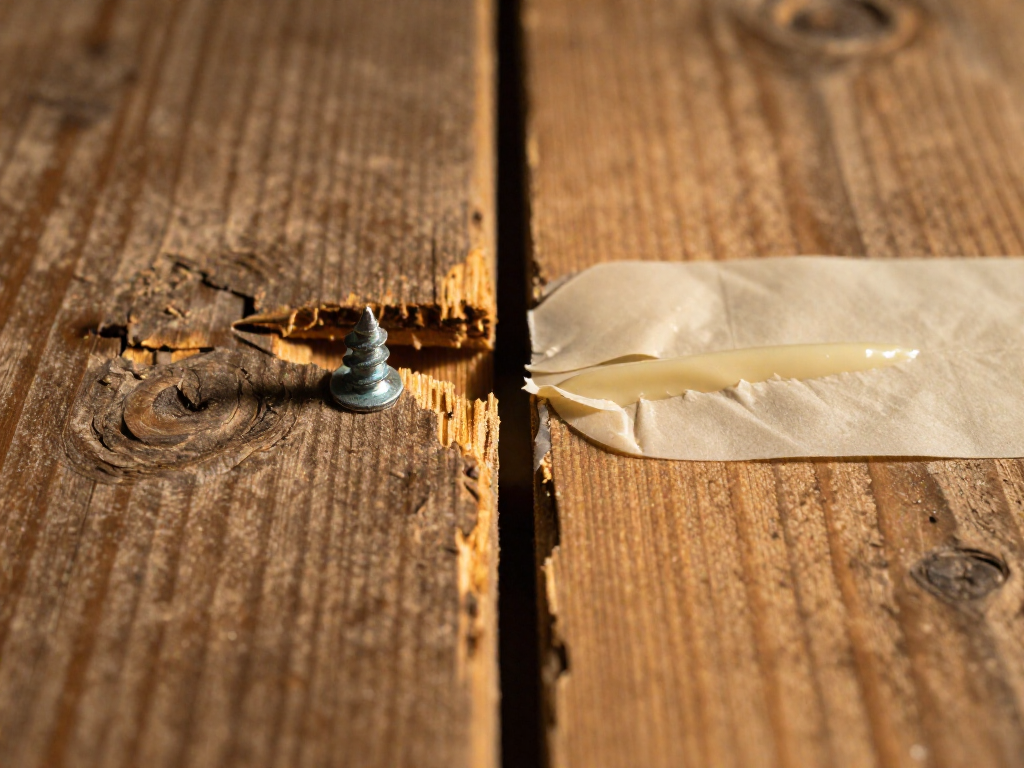
When you drive a screw through your exterior trim, siding, or decking, you're not just making a mechanical connection—you're puncturing the material's natural defenses. Every hole becomes an entry point for water, which migrates into the substrate, freezes and thaws, and eventually causes rot or delamination. Even stainless or coated fasteners can't stop wicking along the thread path; once moisture gets in, the wood or composite fibers swell, the hole loosens, and the holding power degrades. That's the slow, invisible cost you've already paid before the screw shows a speck of rust.
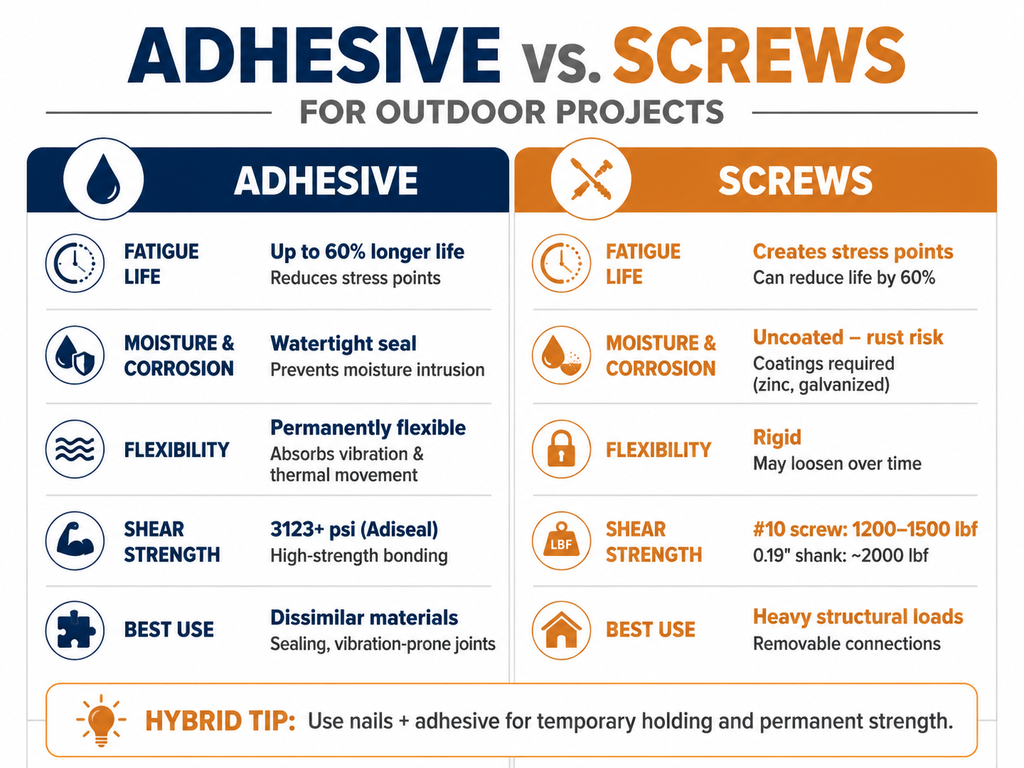
But that's only part of the penalty. Drilling a hole also creates a stress riser—a sharp discontinuity in the material that concentrates loads. In dynamic outdoor conditions (wind buffeting on a fence panel, vibration from a gate, thermal expansion of metal cladding), those concentrated stresses are a direct path to crack propagation. Mechanical fastening can slash a structure's fatigue life by as much as 60% compared to adhesive bonding, according to testing cited by Seal-Bond. That means a joint that would last 10 years with adhesive could fail in just 4 when screwed together, simply because the fasteners create weak points.
Contrast that with a continuous adhesive bond line. A well-chosen modern adhesive—whether it's a flexible MS polymer, a toughened epoxy, or a moisture-curing polyurethane—will fully seal the joint against water, vapor, and even airborne salt. There's no gap for capillary action to draw moisture behind the surface. The bond is inherently watertight. And because the load is distributed across the entire overlap area rather than a few pinpoint holes, there are no stress concentrations to drive fatigue. The adhesive layer also stays compliant, allowing materials with different coefficients of thermal expansion (like a PVC trim board on a metal stud) to move independently without cracking or loosening. Screws, by contrast, fight that movement until the material around the hole fails.
None of this means you should toss your drill entirely. For structural framing or high-shear connections, mechanical fasteners have their place, and hybrids (where nails act as temporary clamps while adhesive sets) can give you the best of both worlds. But for any project where you're trying to keep moisture out and make the assembly last—think exterior trim, fascia boards, decorative brackets, or mounting plastic to metal—adhesives let you skip the holes and the hidden costs they carry.
Strength Showdown: Adhesives vs. Screws in Shear
When you compare a screw’s shear strength to an adhesive’s bond, you’re not looking at the same kind of load. A screw handles a point load — all the force concentrates right at the shank. A standard #10 wood screw can take 1,200 to 1,500 pounds-force in shear, which sounds impressive until you realize that an adhesive spreads the same force across the entire glued surface.
That’s why adhesive specs are reported in psi. Take Adiseal, for example: in independent wood-to-metal testing, it hit over 3,123 psi. Even a modest 1-square-inch bond patch would hold 3,123 lbf — more than double a typical screw. And because adhesives distribute load evenly, they don’t create the stress risers that make screw holes crack and elongate over time. In fact, studies show that mechanical fastening can reduce a structure’s fatigue life by up to 60% compared to adhesive bonding (Seal-Bond). Outdoors, where wind, vibration, and temperature swings are constant, that distributed grip matters.
Screws do give you withdrawal resistance, but that works against you when wood expands and contracts seasonally — the threads can chew up the fibers, loosening the connection. A flexible adhesive moves with the substrate instead of fighting it. Standard epoxy often gets brittle; after a few freeze-thaw cycles, it’ll crack and let go. Adiseal stays permanently flexible, and if you need a two-part epoxy that won’t quit under thermal shock, something like Master Bond EP37-3FLF is formulated for that. Either way, the bond stays watertight, blocking moisture and corrosion that would eat a metal fastener from the inside.
The bottom line: if you’re attaching trim, decorative panels, or non-structural brackets outdoors, a properly prepared adhesive joint can match or exceed the strength of screws — and it won’t leave holes that invite rot. For anything load-bearing or safety-critical, get an engineer’s sign-off. For the rest of your project, a tube of the right adhesive might be the only fastener you need.
Why Flexibility Matters More Than Raw Strength Outdoors
Pick up an aluminum railing section on a hot afternoon and it’s measurably longer than it was at dawn. Plastic trim beside it hardly moves at all. That gap—the difference in thermal expansion between two bonded materials—is what quietly destroys rigid glue joints outdoors. It’s not about sheer pull-off force; it’s about the silent, repeating stress that comes with every sunrise.
Aluminum expands roughly 0.000013 inches per inch for every degree Fahrenheit it warms. PVC? About 0.00003. That’s more than double. Glue a rigid plastic bracket to a metal post with standard two-part epoxy and the bond line has to absorb all of that accumulated movement. Standard epoxies can’t. They’re brittle. Over a few seasons of freeze-thaw cycles and summer heat, microcracks spread, moisture creeps in, and one morning the bracket just falls off. Adiseal’s testing confirms what field experience shows: rigid epoxies weaken over time as temperature and humidity force materials to expand and contract at different rates. The adhesive becomes brittle and eventually breaks.
This is where permanently flexible adhesives earn their keep. By remaining elastic, they act like a cushion, absorbing differential movement without tearing at the bond interface. As Master Bond engineers note, when you’re bonding dissimilar substrates—metal to plastic, glass to metal—compliant, flexible compounds are often the only way to avoid stress fractures from mismatched thermal expansion. The right adhesive stretches and recovers, cycle after cycle, instead of fighting the physics.
That flexibility also handles vibration, the other outdoor bond-killer. A gate latch rattled by wind, a mailbox post next to a busy road, a gutter bracket jostled by ladders—all deliver thousands of low-force impacts. A flexible adhesive damps those vibrations, while a rigid one transmits them straight into the glue line. Adiseal, for instance, is formulated to remain permanently flexible, absorbing shock and allowing the bonded parts to move independently without losing grip. Its strength is no slouch either: in a wood-to-metal shear test, it topped 3,123 psi, while typical construction adhesives hovered under 1,200 psi. But the real story isn’t that one number; it’s that the strength stays consistent because the joint isn’t slowly cracking apart.
For exterior signs, composite decking clips, metal-to-plastic furniture repairs, or any joint where two materials with different personalities have to live together, skip the rigid “strongest” glue. Look for a flexible epoxy like Master Bond EP37-3FLF, which is designed to resist severe thermal cycling and shock, or a permanently flexible sealant-type adhesive. The spec that matters outdoors isn’t the peak psi on the label—it’s elongation percentage, Shore hardness, and the simple phrase “permanently flexible.” That’s what keeps your work together while the weather does its worst.
Weatherproofing: How Adhesives Prevent Corrosion and Decay
When you drive a screw into wood or metal, you create a direct pathway for water and air to reach the substrate. Adhesives take the opposite approach. They form a continuous, watertight seal that completely denies moisture and oxygen access to metal parts, dramatically reducing the risk of corrosion. As Seal‑Bond notes, adhesive bonding creates a sealed joint that prevents moisture intrusion over time—unlike mechanical fasteners that leave gaps around every fastener hole.
That seal does more than just keep the rain out. It electrically isolates dissimilar metals so you can join aluminum to steel without inviting galvanic corrosion. Normally, when two different metals meet in the presence of an electrolyte (like wet wood or a salty coastal breeze), one sacrifices itself to protect the other. By eliminating the electrical pathway, adhesives stop this reaction cold. That isolation is what lets you mate a stainless steel bracket to an aluminum post without the aluminum turning to dust a year later. The same barrier blocks moisture from wicking into wood fibers, preventing the rot that so often starts around screw holes in deck boards and fence posts.
Coated screws certainly help—hot-dip galvanizing and ceramic coatings extend the life of a mechanical connection. But those coatings are only surface-deep, and every time a bit drives through them, the barrier is compromised. An adhesive fills the entire joint, enveloping the materials in a uniform layer. There is no exposed thread, no micro-crack where water can wick in. For lasting weather protection, choose an adhesive that cures with some give. A rigid epoxy might crack under repeated thermal movement, opening a new path for moisture; a flexible, exterior-grade adhesive will ride out the daily swing of expansion and contraction, keeping the seal intact season after season.
The Nail-and-Glue Hybrid: Temporary Fastening with Permanent Bond
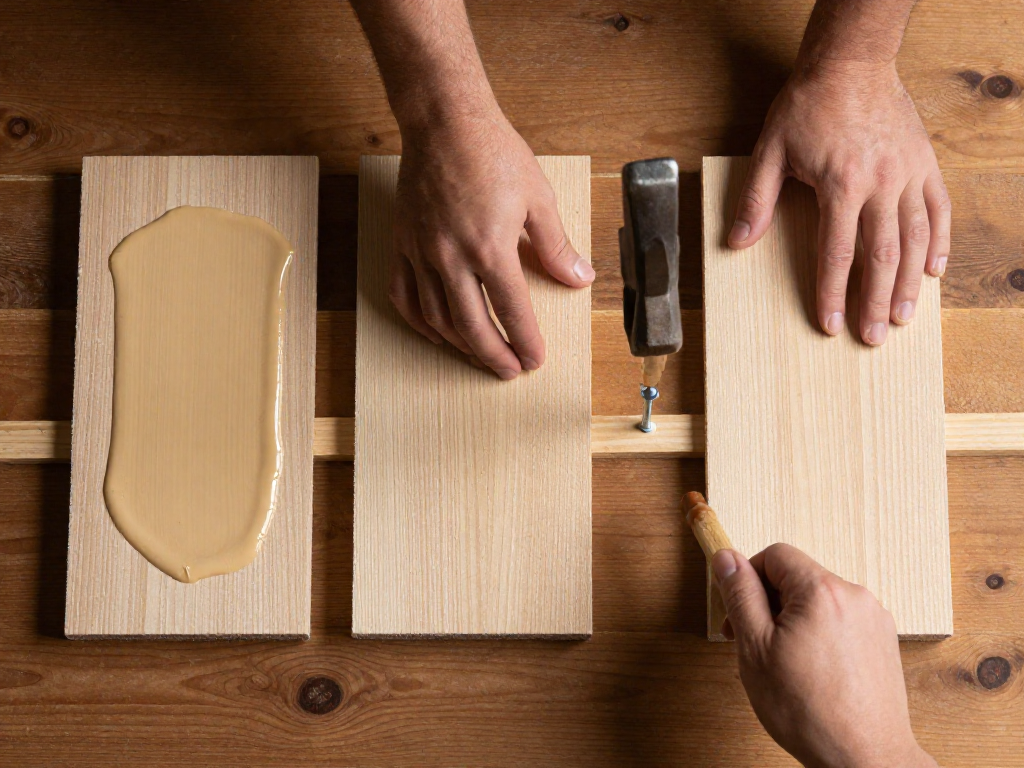
Brad nails and construction adhesive make a surprisingly effective outdoor pairing: the nails act as instant clamps, holding trim or siding exactly where you want it while the adhesive cures, and then the glue takes over as the permanent, weather-resistant bond. In one demonstration, joints made this way with brad nails and glue ended up just as strong as screwed connections (The Honest Carpenter).
This hybrid solves two problems at once. You get the speed and clean look of nailing—no heavy clamping, no visible fastener heads—while the adhesive compensates for the way nails gradually lose grip as wood swells and shrinks with the seasons. Once cured, it's the glue line that carries the load, not the tiny brads.
For exterior trim, clapboard repairs, or decorative brackets where you'd rather not see screws, this method is a genuine time-saver. Just make sure your adhesive is rated for outdoor flexibility; a brittle bond will crack as temperatures cycle, but a permanently flexible one moves with the materials and stays watertight.
When Screws Still Make More Sense
Adhesives are impressive, but they aren’t always the right tool. Some outdoor situations simply demand the old-school reliability of a screw.
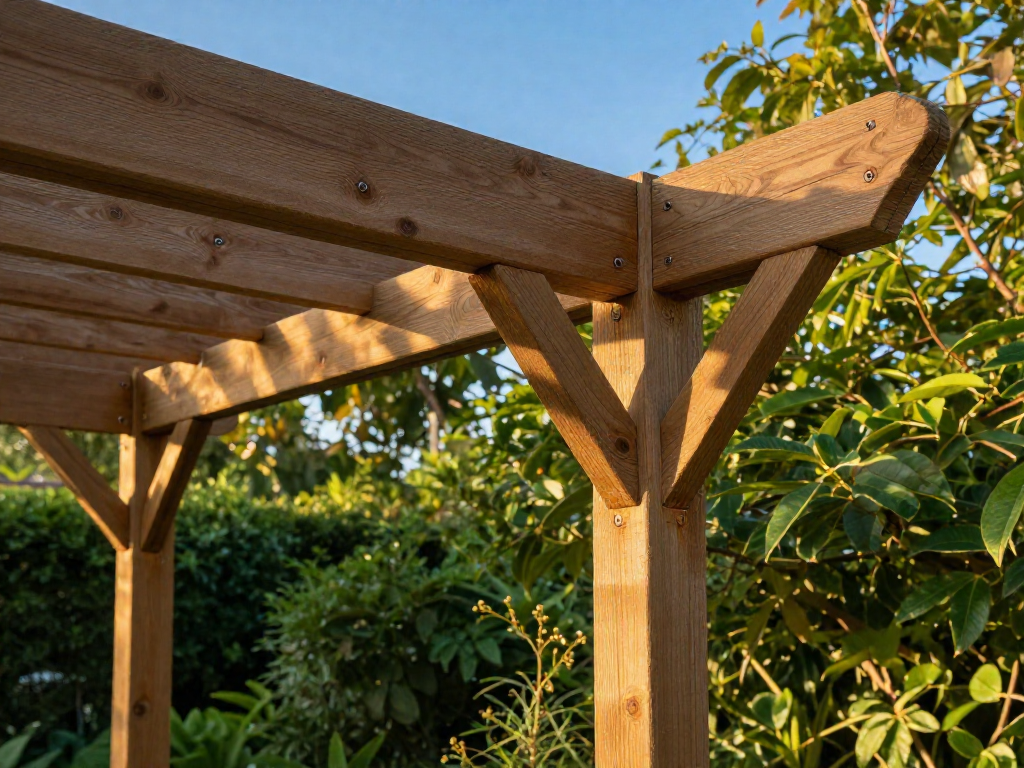
Disassembly is the obvious showstopper—if you’ll ever need to take something apart for maintenance or modification, a permanent bond becomes a problem. Likewise, screws take a load immediately; there’s no waiting for a cure. When you’re anchoring a heavy planter bracket or a gate hinge, the instant holding power of threads matters. While a hybrid nail-and-glue joint can achieve screw-like strength once fully cured, screws deliver that grip from the moment they’re driven (as shown in a NAILS vs. SCREWS comparison).
Certain materials, like polyethylene or polypropylene, repel adhesives so well that mechanical fasteners are often the only reliable option. And for structural framing or any project governed by building codes, the spec sheet almost always mandates approved mechanical fasteners—no adhesive shortcut will pass inspection. Never rely on adhesives alone for safety‑critical, load‑bearing connections.
How to Choose the Right Outdoor Adhesive
Start by pinning down exactly what you're joining. Bonding plastic to metal, for instance, trips up a lot of DIYers because the two materials expand and contract at completely different rates when the sun hits them. If your adhesive can't stretch with that movement, the bond will crack and fail. That's why rigid options like standard epoxy are often the wrong call outdoors—manufacturers like Master Bond explicitly note that compliant (flexible) compounds are necessary to absorb stresses from mismatched thermal expansion.
Flexibility is non-negotiable for anything that sees temperature swings, vibration, or wind load. Look for an adhesive that stays permanently elastic, not just rubbery for the first year. Adiseal is engineered to remain flexible for life, absorbing vibration and letting materials move without weakening the bond—and in independent wood-to-metal shear testing, it hit over 3,123 psi, more than triple some common construction adhesives. If you need a specialised two-part system, Master Bond's EP37-3FLF is a flexible epoxy built to handle severe thermal cycling and shock. Either way, skip anything labeled simply "high strength"—outdoors, that usually means brittle.
Waterproofing is another must. A good exterior adhesive forms a continuous, watertight seal that keeps moisture from creeping behind siding or into joints, actively preventing the rot and corrosion that screws can invite. Check the technical data sheet for a D4 or equivalent waterproof rating if you’re bonding wood, and for UV resistance if the glue line will see direct sunlight. Gap-filling ability matters too: outdoor surfaces are rarely perfectly flat, and a thicker bond line that can bridge unevenness while still curing properly is worth its weight in saved sanding.
Don’t skip surface prep. Most failures come from dirty, glossy, or oily substrates. Scuff both surfaces with sandpaper or a Scotch-Brite pad, wipe them down with isopropyl alcohol, and let them dry fully. If the adhesive manufacturer recommends a primer for one of the materials—common with certain plastics and metals—use it. That extra five minutes of prep often doubles the lifetime of the bond.
Sources
- Mechanical Fastening vs. Adhesive Bonding — seal-bond.com
- PLASTIC TO METAL GLUE: Strong, Flexible, Waterproof, Durable — adiseal.com
- Adhesives for Bonding Plastic to Metal | MasterBond.com — masterbond.com
- Shear Strength of Screws & Fasteners: Comprehensive Guide and Comparison — fastenersystems.com
- NAILS vs. SCREWS...Which Should You Choose?! (Pros + Cons of Nails And Screws For Your Projects!) — youtube.com
See also
- Plastic to Metal Bonding Outdoors
- Weatherproof Adhesive Guide
- Screw vs. Nail for Fencing
Related articles
Humidity-Tolerant Adhesives: Bonding in Moist Climates Without Blushing
Which adhesives cure properly in very humid environments?
Jul 22, 2026 · 5 min read
DIY Car Repair Adhesives: Fixing Trim, Lights, and Panels That Last
Compare double-sided tape, epoxy, and polyurethane for car trim, panel, and headlight repairs. Data-backed guide with real adhesion strengths and weather durability.
Jul 22, 2026 · 8 min read
Vibration-Resistant Adhesives: Keeping Bonds Tight in Machinery and Vehicles
Choose an adhesive that won't crack or loosen under constant vibration. Compare flexible polyurethanes, toughened epoxies, and silane-modified polymers for dynamic loads.
Jul 22, 2026 · 9 min read