Vibration-Resistant Adhesives: Keeping Bonds Tight in Machinery and Vehicles
How do I choose an adhesive that won't crack or loosen under constant vibration?
On this page
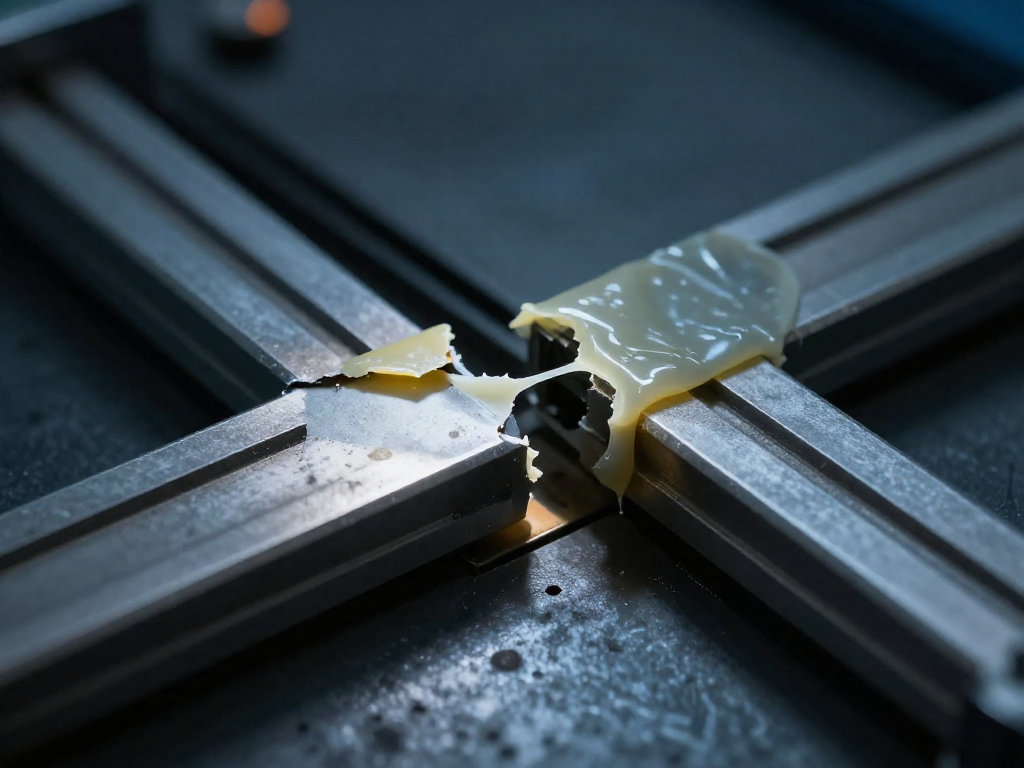
Setting the scene with a common problem: a repair on a vehicle or machine that keeps failing due to vibration. Then pose the primary question: How do you choose an adhesive that actually lasts under these dynamic conditions?
Why Standard Adhesives Fail Under Vibration
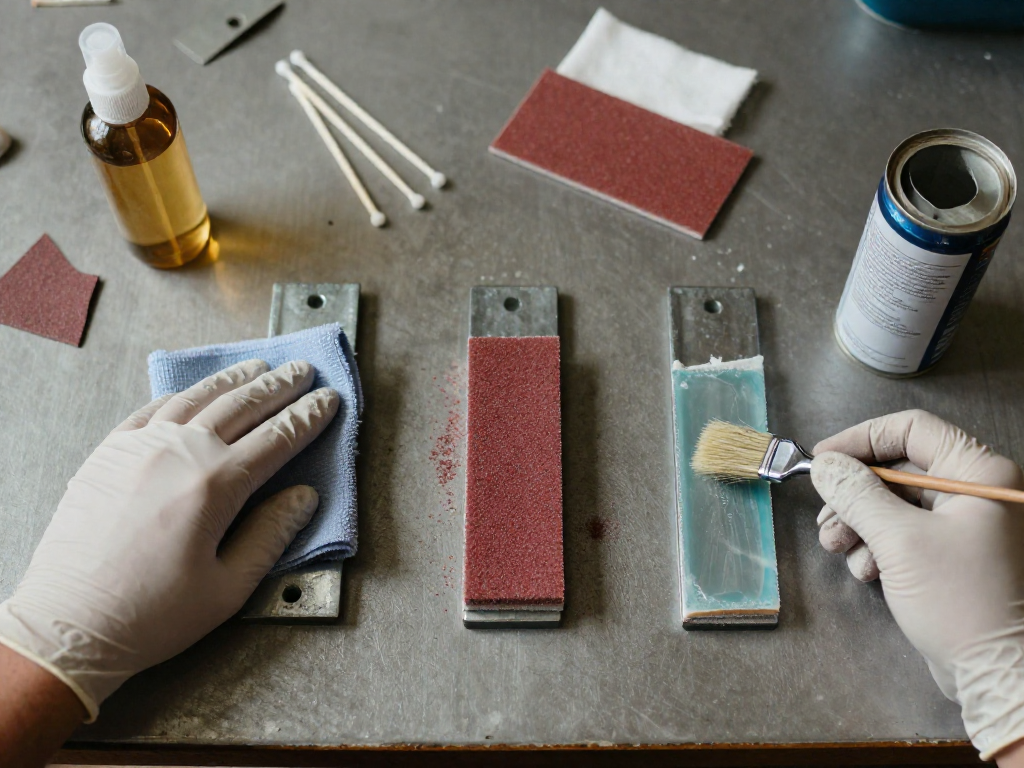
The key to a vibration-proof bond is understanding that most standard adhesives fail in one of two ways: they either crack because they’re too stiff, or they peel and creep because they’re too flexible.
Most shop-grade epoxies and cyanoacrylates are fundamentally brittle. Their rigid molecular structure creates a strong static grip, but it also concentrates stress right at the bond line. When a machined part or vehicle panel vibrates, it sends thousands of tiny shockwaves through the adhesive every minute. These micro-stresses initiate hairline cracks that grow with each cycle, even when the peak force is well below what the adhesive could hold in a single pull. According to fatigue research from the National Physical Laboratory (NPL), damage can accumulate “at relatively low stress levels, particularly in the presence of hostile environments” like moisture, temperature swings, or oil contamination. The result is a bond that looks fine one day and fails without warning the next.
Going fully flexible to avoid cracking creates a different problem. Polyurethane and similar elastomeric adhesives absorb vibration energy by deforming elastically, but they’re prone to creep under sustained load and can peel away from rigid substrates over time. A bond that constantly stretches and relaxes under vibration may slowly thin and lose strength, especially if heat softens the adhesive further. The ASTM D3166 shear fatigue test was developed precisely because engineers needed a way to measure how an adhesive performs under this kind of repeated, dynamic stress—not just a one-time yank.
The solution isn’t choosing between brittle and rubbery; it’s using a toughened adhesive system that balances both. Silane-modified polymer (SMP) formulations, for example, can achieve elongation at break values of nearly 300% while maintaining tear strengths above 35 N/mm, making them dramatically more durable in vibrating machinery than an unmodified, rigid epoxy. That kind of engineered flexibility—often found in adhesives designed for aerospace or automotive bonding—is what separates a permanent repair from a recurring failure. And when hostile conditions are present—road salt, engine heat, or UV exposure—the need for a fatigue-rated adhesive with proper surface preparation becomes absolute.
The Flexibility-Strength Tradeoff: Choosing the Right Adhesive Chemistry
A rigid adhesive seems like the strong choice—until it cracks. Under vibration, strength alone isn’t the answer; the chemistry that keeps molecules locked in place can also make them shatter like glass when the load changes a thousand times a second. The real measure of a vibration-resistant bond is how it trades ultimate tensile strength for flexibility, and the right choice depends entirely on what you’re joining and how it moves.
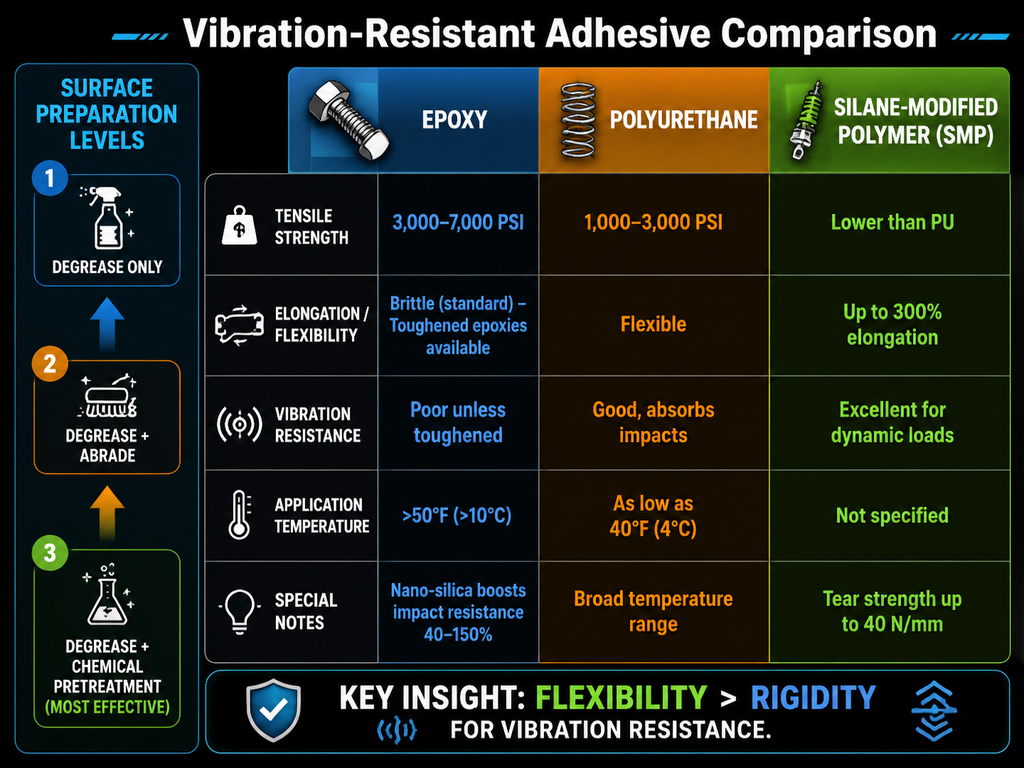
Standard two‑part epoxies are the heavy lifters of the adhesive world, routinely delivering 3,000 to 7,000 PSI of tensile strength. That’s plenty for a static repair—a bracket that never budges, a fixture bolted to a wall. But the same rigid cross‑linked structure that gives epoxy its muscle also makes it brittle. In a vibrating environment, that stiffness concentrates stress into micro‑cracks that propagate until the bond fails, often without warning. You don’t need a bigger hammer; you need a material that can bend a little before it breaks.
Polyurethanes solve that problem by lowering the strength bar to between 1,000 and 3,000 PSI while offering dramatically more give. They stretch, recover, and literally sponge up vibration energy that would shatter an epoxy joint. That makes them ideal for bonds that see constant, low‑amplitude movement—things like vehicle trim, motor mounts, or plastic panels that flex with temperature swings. The tradeoff is clear: you sacrifice ultimate holding power for day‑to‑day survival under dynamic loads. If your joint is more about staying attached than bearing heavy weight, polyurethane is often the smarter call.
When you need both—high strength and the ability to shrug off vibration—look to toughened epoxies. These formulations embed rubber particles, core‑shell modifiers, or nano‑scale fillers that act as microscopic shock absorbers. The difference is staggering: adding nano‑silica to an epoxy can boost impact resistance by 40–150% (SpecialChem), while still holding onto much of the original tensile strength. Specific products like Master Bond’s EP21TDC‑4ND push elongation past 200% and are explicitly designed to resist mechanical vibration and shock. For machinery, pumps, or automotive brackets that combine a real structural load with relentless vibration, this is the category that closes the gap between strength and toughness.
Beyond epoxies and polyurethanes, silane‑modified polymers (SMPs) offer a performance profile that’s almost tailor‑made for dynamic joints. These adhesives don’t quite reach polyurethane’s tensile strength, but they can stretch to nearly 300% elongation at break—outpacing even the most flexible polyurethanes. That extreme elongation makes them especially useful for bonded joints that see repeated high‑energy loads, as in rail vehicles, heavy trucks, or white goods where the entire assembly flexes with every bump or spin cycle. If your application involves large, thin panels that whip back and forth, SMPs are worth a serious look.
How do you choose? Start by classifying the load. A truly static joint—a vanity that never moves, a non‑structural trim piece—may be perfectly happy with a rigid standard epoxy. Once vibration enters the picture, skip straight to polyurethane if ultimate strength is secondary. For structural parts that also shake (think engine accessories, gearbox housings, or industrial mounts), a toughened epoxy hits the sweet spot. And if the dynamic movement is extreme and the bond line must roll with the punches, SMPs give you the most headroom. In every case, dig past the generic “strength” numbers and look for elongation at break and impact resistance data—those tell you how the adhesive performs when the world isn’t sitting still.
Silane-Modified Polymers (SMPs): The High-Elongation Alternative for Extreme Vibration
For joints that live with constant pounding—think vehicle chassis, washing machine tubs, or rail car interiors—a rigid adhesive is a disaster waiting to happen. Standard epoxies crack. Even flexible polyurethanes can reach their limit when the shaking never stops. That’s where silane-modified polymers step in. SMPs offer an elongation-at-break pushing 300%, which dwarfs typical polyurethanes and makes them far more forgiving under repeated dynamic loads.
WACKER’s Geniosil XT 50 and XT 55 show exactly what this class can do. These silane-terminated polyethers are clear, low-viscosity liquids—just 500 and 1,200 mPa·s—so they flow easily into gaps and wet out surfaces without making a mess. WACKER reports tear strength as high as 40 N/mm, and when you combine that with an elongation that can reach nearly 300%, you get a bond that doesn’t just stretch—it stretches without tearing. That’s huge when the joint experiences high-amplitude vibration. A polyurethane might have slightly higher tensile strength on paper, but its elongation often tops out well below 200%. In a fatigue-prone environment, elongation usually matters more than raw tensile strength, because the adhesive needs to deform repeatedly without cracking.
Why does that matter? Fatigue damage in bonded joints can kick in at surprisingly low stress levels, especially when humidity or temperature swings stack on top of mechanical cycling. A high-elongation adhesive essentially gives the joint a longer fatigue life by spreading the stress over a larger deformation rather than concentrating it at a microscopic crack tip. This is why SMPs show up in road and rail vehicles, where suspension components, body panels, and interior fixtures see millions of cycles. They’re also common in white goods—washing machines and dryers—where spin cycles create constant shaking and impact.
SMPs bond well to metals and many plastics without needing a primer, which simplifies assembly or repair. And unlike some tough epoxies that need heat to cure, SMPs typically cure at room temperature with moisture. The low viscosity also means you can use them for potting or sealing applications where vibration damping is part of the job. The trade-off is real: they won’t match a quality polyurethane in ultimate tensile strength. But if your joint’s failure mode is fatigue cracking rather than a slow, steady pull, the extra elongation will keep the bond alive longer. For extreme vibration, SMPs are the smarter choice.
Surface Preparation: The Make-or-Break Step for Vibration-Proof Bonds
Surface prep isn't the first step—it's often the difference between a repair that holds for years and one that falls apart the first time the engine turns over. Even the best vibration-resistant adhesive will fail if it's bonding to oil, rust, or mold release. The good news: you don't need a cleanroom. A proven sequence will get you there.
Follow the preparation hierarchy that 3M has documented for structural adhesives: degrease, then abrade and solvent-clean, and finally chemically pre-treat for the strongest bonds (3M). Each level builds on the last. Degreasing alone—wiping with isopropyl alcohol or acetone—might be enough for a lightly loaded or temporary fix, but under vibration you want to go further.
Abrading with 80- to 120-grit sandpaper creates a micro-rough surface that gives the adhesive more area to grab onto. After sanding, clean away the dust with a solvent. For metals, that's often enough, but if you can chemically pretreat (an acid etch for aluminum, or a phosphoric acid wipe on steel), you'll create a reactive surface that forms covalent bonds rather than just mechanical ones. The difference can be dramatic.
Plastics need a different approach. Abrasion helps, but many plastics have low surface energy. Flame treatment or a quick pass with an adhesion promoter (like a silane-based primer) can raise the surface energy enough for the adhesive to wet out properly. A final wipe with a clean, lint-free cloth and solvent right before the adhesive cures is cheap insurance against vibration.
Testing and Standards: What to Look for When Selecting Adhesives
Standard lap-shear or tensile-strength numbers on a technical data sheet won't tell you whether the bond will survive a decade of engine vibration. Those tests measure ultimate failure in a single, slow pull. Vibration is a fatigue problem—small repeated forces that eventually initiate cracks and cause failure at stresses well below the one-time breaking point.
The test you want to see is ASTM D3166. It measures shear fatigue life by cycling a bonded lap-shear specimen through millions of load cycles and recording how many cycles it takes to fail at a given load level (Infinita Lab). This is as close as adhesive testing gets to simulating real-world vibration on your vehicle or machine. If a manufacturer publishes fatigue data—especially S-N curves—you're looking at an adhesive they trust under dynamic conditions.
For bonds that will face sudden shocks, also check ASTM D950, the standard impact test. It quantifies how an adhesive handles a short, sharp blow—the kind of jolt that can shatter a brittle epoxy instantly even if its static strength is impressive. Adhesives that pass both fatigue and impact testing typically combine high flexibility or elongation with strong adhesion.
So when you scan a data sheet, look past the headline lap-shear number. High lap shear alone does not guarantee vibration resistance. Instead, look for phrases like “high elongation,” “toughness,” or explicit mention of ASTM D3166 and D950 results. A flexible adhesive that can elongate 200% or more before breaking will often outlast a stiffer, higher-strength one in a vibrating assembly.
Quick Answers to Common Vibration Bonding Questions
Can I use super glue (cyanoacrylate) for vibrating parts? Standard CA is too brittle—vibration causes it to crack. Rubber-toughened versions add some flexibility, but they remain non-structural and are not reliable for dynamic loads.
Does vibration always mean I need a flexible adhesive? Not always. If the joint is rigid and well-clamped, a toughened epoxy can survive. But flexibility is the safer bet. Formulations like Master Bond EP21TDC-4ND exceed 200% elongation and are engineered to resist shock and vibration.
Is threadlocker a substitute for a vibration-resistant adhesive? No. Threadlockers prevent threaded fasteners from loosening; they’re not structural adhesives. They can’t carry shear or peel loads and will fail quickly if used to bond components.
Sources
- PU Glue vs Epoxy Strength: Real Numbers (MPa Test) | SPC Adhesives — puglue.com
- New Toughening Agents (Micro & Nano) for Structural Adhesives — specialchem.com
- [PDF] sealants - Wacker Chemie AG — wacker.com
- High Elongation Adhesives | MasterBond.com — masterbond.com
- ASTM D3166 Adhesive Shear Fatigue Properties Testing | Cyclic Lap Shear | Infinita Lab — infinitalab.com
- Fatigue and creep testing of adhesives and thermoplastic ... — eprintspublications.npl.co.uk
- Surface Preparation and Pretreatment for Structural Adhesives — multimedia.3m.com
- Industry Standards - Adhesives/Sealants.org — adhesives.org
See also
- Material-specific bonding guides: plastic to metal, metal to metal, rubber to metal
- Guide to surface preparation for difficult substrates
- Overview of adhesive types for outdoor and automotive use
Related articles
Humidity-Tolerant Adhesives: Bonding in Moist Climates Without Blushing
Which adhesives cure properly in very humid environments?
Jul 22, 2026 · 5 min read
DIY Car Repair Adhesives: Fixing Trim, Lights, and Panels That Last
Compare double-sided tape, epoxy, and polyurethane for car trim, panel, and headlight repairs. Data-backed guide with real adhesion strengths and weather durability.
Jul 22, 2026 · 8 min read
Outdoor Fastener Alternatives: When Adhesives Beat Screws for Exterior Projects
In outdoor projects, when should I use adhesive instead of mechanical fasteners?
Jul 22, 2026 · 10 min read