UV-Cure Adhesives (Liquid Optical Clear Adhesives): Perfect for Glass and Electronics
What is UV glue, and when should I use it instead of regular super glue?
On this page
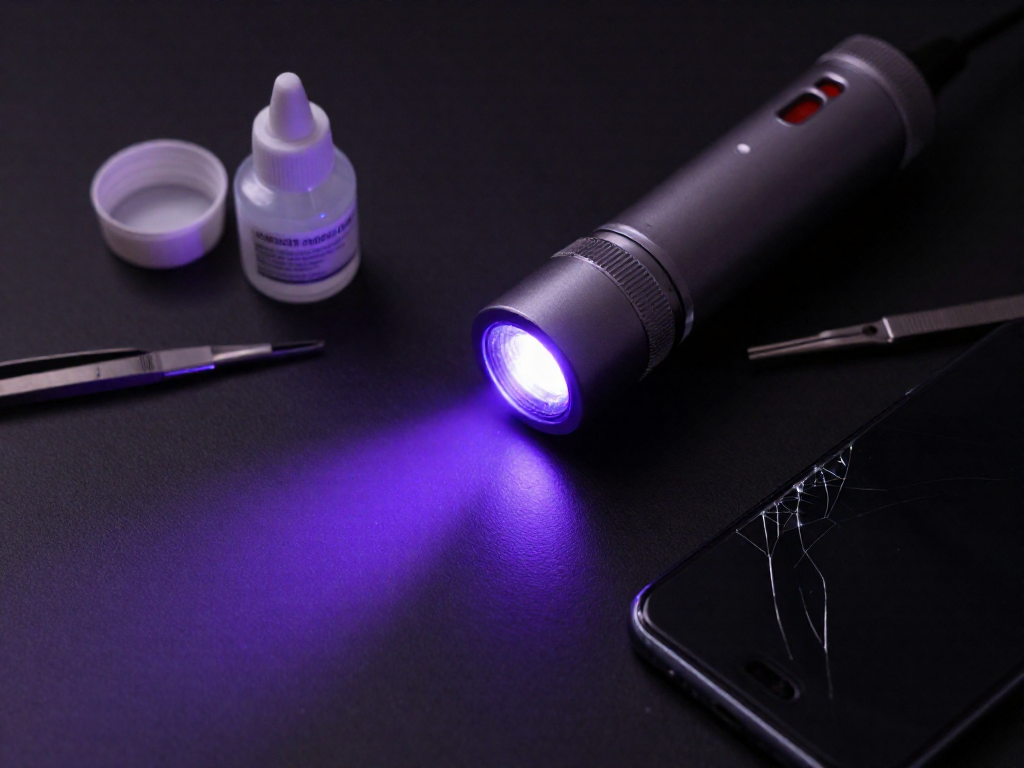
How UV light cures adhesive instantly; best for transparent materials and small, precise bonds.
What Is UV Glue and How Does It Work?
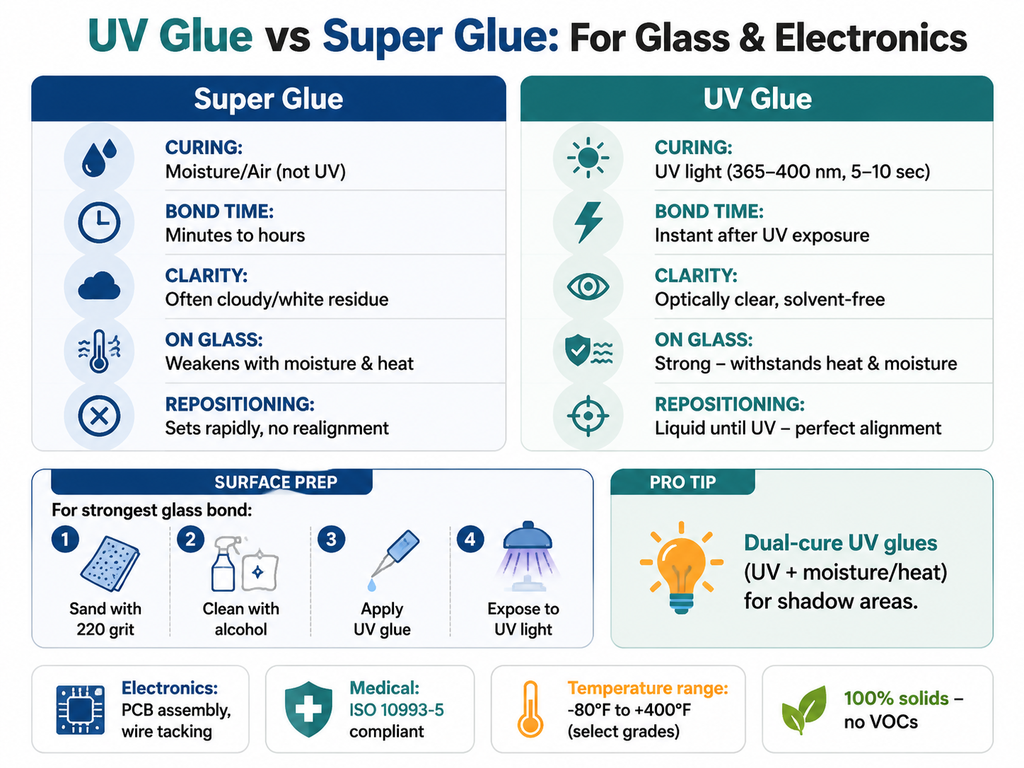
UV glue—often called Liquid Optical Clear Adhesive (LOCA)—isn’t your typical tube-of-glue. It stays liquid until you shine a UV light on it, then cures to a rock-hard, crystal-clear bond in seconds. That’s why it beats regular super glue for transparent repairs: you get unlimited time to align parts, no messy clamping, and a near-invisible seam that won’t yellow or fog.
Inside every UV adhesive are photoinitiators, small molecules that spring into action when hit by the right light wavelength (typically 365–400 nm). They kick off photopolymerization, instantly linking the liquid monomers into a solid polymer matrix. As Permabond explains, this means you can dispense the adhesive, position your pieces perfectly, and only then hit the “freeze” button with a UV lamp. Curing takes as little as 5–10 seconds, and the result is optically clear—ideal for phone screens, glass tabletops, and jewelry.
Standard super glue won’t cure under UV; it relies on moisture in the air. For shadowed areas that light can’t reach, look for dual-cure formulas that also set via moisture or heat. But for clean, transparent bonds that need instant strength, UV adhesives are the tool for the job.
UV Glue vs. Super Glue: Why UV Wins for Glass & Clear Repairs
For glass and truly invisible repairs, UV-cure adhesive leaves super glue in the dust—and once you understand why, you’ll never reach for the little tube by default again.
Super glue (cyanoacrylate) cures when it meets moisture, typically from the air or the bonding surfaces. Shine a UV lamp on it all day and nothing will happen—it simply isn’t triggered by light. That moisture mechanism becomes a problem on non-porous glass: the glue can’t absorb into the surface, so a tiny amount can pool, create a hazy white bloom, and form a weak, brittle bond. Even worse, it grabs on contact. You get exactly one shot at alignment; any adjustment after the parts touch tears the bond and compromises strength.
UV glue turns that dynamic on its head. It stays liquid until you hit it with the right wavelength (usually 395 nm), so you can nudge parts into perfect position, verify everything fits, then cure the whole assembly in seconds. No rushing, no wasted parts.
Strength tells the same story. In a head-to-head test where adhesives were blasted with a heat gun for 40 seconds, a UV resin bond on glass didn’t budge—the tester described it as practically welded on (Craft Klatch). Super glue and even some epoxies failed under that heat stress. A little surface prep—scuffing the glass with 220-grit sandpaper and cleaning with rubbing alcohol—pushes UV bond strength even higher, giving the adhesive something to grip mechanically before the light seals it.
Then there’s the look. UV adhesives cure truly optically clear and resist yellowing, while many cyanoacrylates degrade to an ugly amber haze over time. For anything transparent—a chipped wine glass, a cracked phone screen protector, a jewelry repair—that clarity is the whole point. Unless you’re filling a gap in a porous, moisture-friendly material, UV glue is simply the sharper tool for glass and clear plastics.
Where UV Glue Excels (And Where It Falls Short)
UV glue is unbeatable when you’re bonding clear materials—glass-to-glass, glass-to-acrylic, or placing a smartphone screen back onto its frame. Because the adhesive cures only where the UV light hits, you get a crystal-clear, waterproof seam that hardens in seconds under a 365–400 nm lamp. In electronics, it’s a go-to for wire tacking, conformal coating, and PCB assembly—the fast cure and solvent-free chemistry keep production lines moving with minimal mess.
The hard rule: if light can’t reach the bond line, standard UV glue won’t work. Shadowed joints, lap bonds on opaque metal or dark plastic, and repairs behind an opaque backing are all failures waiting to happen. For those spots, you need a dual-cure formula. These combine UV activation with a backup mechanism—typically moisture or heat—so the adhesive finishes curing even without direct light (Permabond). That’s the smart upgrade for anything less than perfectly transparent.
The Secret to an Unbreakable Glass Bond: Prep and Process
The secret is simple: micro-abrasions and a surgically clean surface. In a head-to-head adhesive test, sanding glass with 220-grit sandpaper followed by rubbing alcohol made the UV resin practically weld to the surface (Craft Klatch). Sand both parts if you can — the difference is dramatic. Apply your UV glue, align the pieces, and cure for 5–10 seconds under a 395nm UV light. That’s it. The resin stays put for years, and the bond stays crystal clear.
Choosing Your UV Glue and Light Source
For reliable results, choose an adhesive that cures at 395–405 nm—this matches most inexpensive UV LED flashlights. Simple starter kits with resin and a 5W light can be found for under $20. Just keep in mind that UV adhesives have a limited shelf life (around 8 months from packaging), so buy only what you'll use soon (Thorlabs).
Sources
- UV Adhesive – Fast Bonding at Your Fingertips — permabond.com
- UV Adhesives - Light cure glue - Fast curing adhesives — vitrochem.com
- Does UV Light Cure All Adhesives? Here’s What You Need to Know - Uvitron International — uvitron.com
- Best Glue for Glass: I Tested 5 Popular Adhesives to Find the Winner - Craft Klatch — craftklatch.com
- Master Bond UV Curable Adhesives | MasterBond.com — masterbond.com
- Thorlabs · UV-Curing Optical Adhesives — thorlabs.com
- How to Use UV Resin as Glue for Clear Glass, Acrylic & Jewelry Repairs — craft-resin.com
- How to use UV Resin on Glass (The best glass adhesive!) — youtube.com
- HOW TO REPAIR GLASS IN 1 MINUTE using UV GLUE — youtube.com
- How UV-Curable Adhesives Improve Efficiency in Electronics Production — padhesive.com
FAQ
Can I use UV glue on plastic?
Yes, but only if the plastic allows UV light to pass through and the adhesive is compatible with that plastic type. Many UV adhesives require line-of-sight to the UV source for curing; if the plastic is opaque or blocks UV, you’ll need a dual-cure adhesive that also cures via moisture or heat in shadowed areas.
Is UV glue waterproof?
Some UV adhesives are waterproof, but not all. For example, Tekk UV 21 is a specially formulated transparent and waterproof UV glue suitable for glass repairs. Always check the product specifications for water resistance before using it in wet conditions.
Can sunlight cure UV glue?
Yes, sunlight contains UV wavelengths that can trigger curing, but it takes much longer than using a dedicated UV lamp. UV adhesives typically cure in seconds under a 365–400 nm UV light source; in direct sunlight, expect minutes to hours for a full cure depending on intensity and the adhesive formulation.
How do I remove uncured UV glue?
Since UV glue remains liquid until exposed to UV light, you can simply wipe it off with a lint-free cloth or paper towel. For residue on surfaces, check the manufacturer’s instructions; often, a mild solvent like isopropyl alcohol will clean it, but test on a hidden area first to avoid damage.
See also
- Super Glue vs Epoxy: Which Should You Use?
- The Ultimate Guide to Gluing Glass
- How to Repair Glass: Step-by-Step
- Electronics Adhesive Guide: Bonding PCBs and Components
Related articles
Contact Cement: The Secret to Laminate, Leather, and Shoe Repairs
How do I use contact cement correctly to avoid bubbles and weak bonds?
Jul 22, 2026 · 5 min read
Structural Adhesives: Understanding MMA and Acrylics for Load-Bearing Metal Bonds
What are structural adhesives, and when do I need them over regular glue?
Jul 22, 2026 · 10 min read
Construction Adhesives Showdown: Liquid Nails, PL Premium, and Loctite PL
Which construction adhesive is strongest for subfloor, paneling, and heavy-duty projects?
Jul 22, 2026 · 8 min read