Cold Weather Bonding: Adhesives That Cure at Freezing Temperatures
Can I use adhesive in freezing weather, and which ones work?
On this page
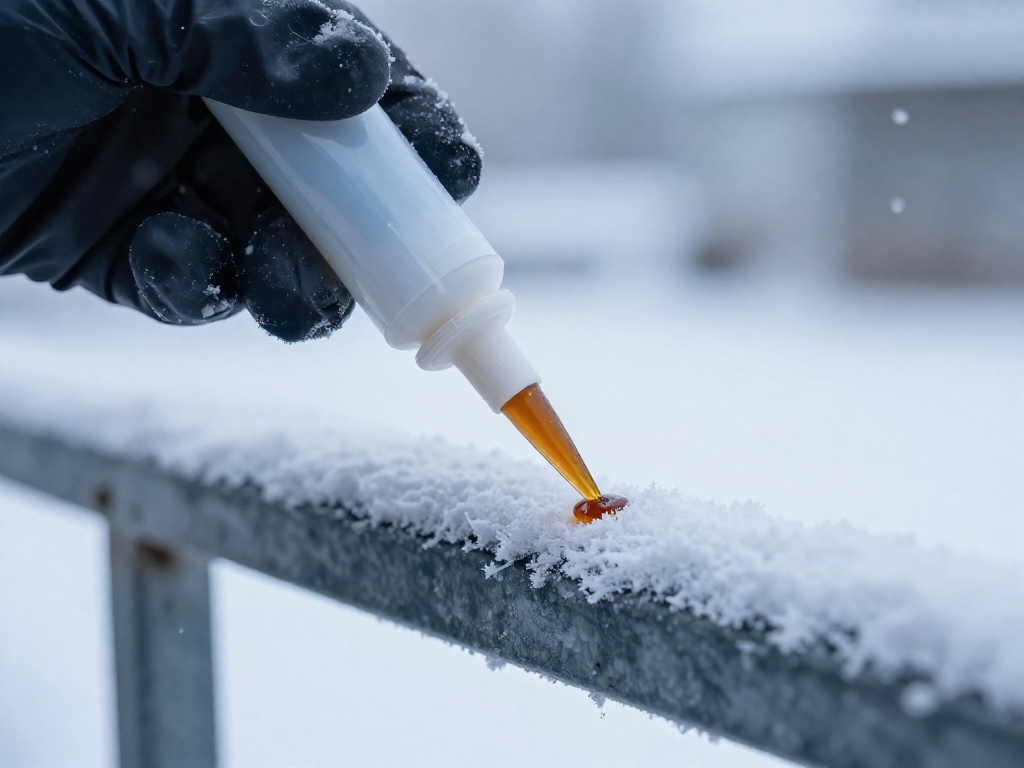
You're mid-repair in 25°F cold, and your standard epoxy just won't set. Not all adhesives are equal in the cold—here are the ones that actually cure below freezing and the science that predicts if your bond will hold.
Why Most Adhesives Let You Down When Temperatures Drop
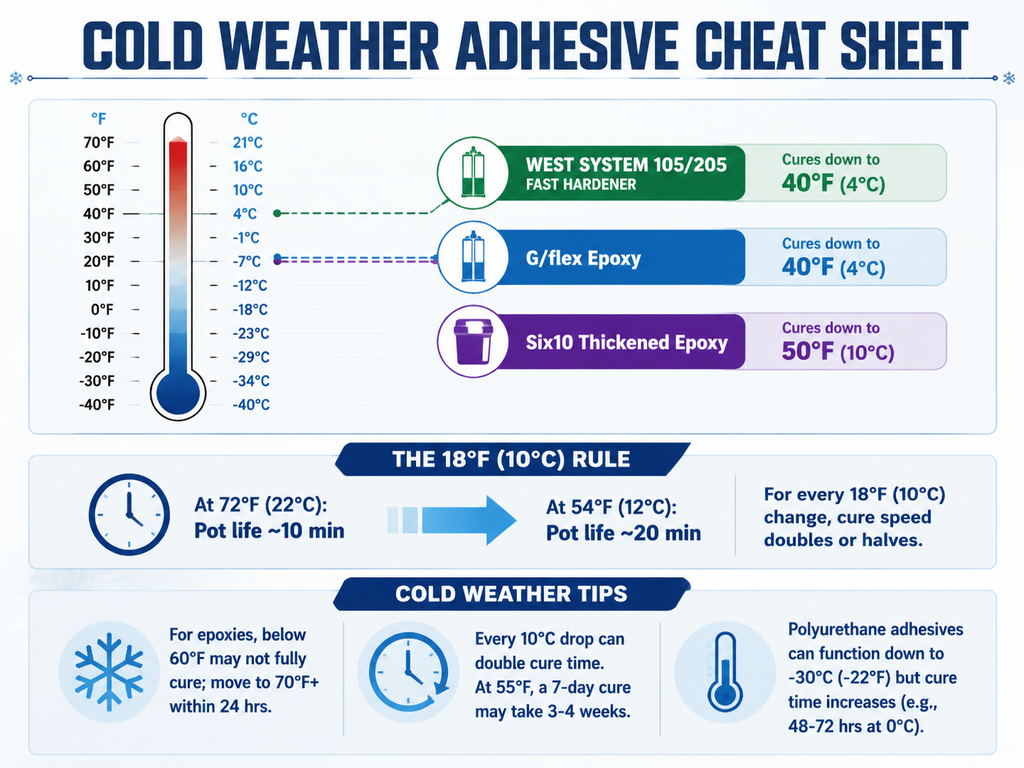
Can you bond in freezing weather? Yes, but only with adhesives built for the cold. Standard adhesives fail because curing is a chemical reaction that crawls as temperatures drop. Every 18°F (10°C) decrease roughly doubles the cure time (WEST SYSTEM Epoxy Tips). At 55°F, a typical epoxy that cures in a week at room temperature can take 3–4 weeks — or stall entirely below 60°F, never reaching full strength. Cold-cure adhesives aren't just marketing; their chemistry is tuned to keep working when others quit.
Adhesives Proven to Work in Freezing Conditions
When the mercury drops, not all adhesives throw in the towel. For serious cold, you need chemistries designed to cure and hold below water’s freezing point. The two broad families that actually work: low-temperature epoxies and polyurethane adhesives.
For epoxy, West System dominates the cold-cure conversation. Their 105 Resin paired with 205 Fast Hardener kicks reliably down to 40°F (4°C). That combination turns a typical 10‑minute pot life at room temperature into about 20 minutes at 54°F, giving you extra working time—handy when gloved hands slow you down. G/flex, their toughened formulation, also cures to 40°F and flexes with the joint, which is useful for dissimilar materials that move at different rates. If you can keep things just a little warmer, Six10 thickened epoxy hits 50°F (10°C), making it easier to fill gaps without sagging.
Polyurethanes take the cold even further. Standard solvent‑free formulations routinely function down to –20°C to –30°C, and specialized grades have been tested as low as –196°C. At –20°C, many formulations still deliver 85–90% of their room‑temperature bond strength, and after 500 freeze‑thaw cycles, they keep over 85% of their initial hold—a brutal durability test that matters if your repair faces winter after winter (PUGlue). That’s the kind of resilience outdoor plumbing, cold‑storage, or vehicle repairs demand.
Be patient with cure times. Expect a polyurethane that sets in 24 hours at room temperature to need 48–72 hours at 0°C. The colder it gets, the more those chemical crosslinks slow, so plan for a longer clamp time. If you’re glueing at –10°C, you might be waiting a couple of days for full strength. Bringing the adhesive and mating surfaces up to a moderate temperature before application can speed things, but even without that, these formulations will eventually cure hard. For truly arctic conditions, check the manufacturer’s data sheet for the exact low‑temperature cure window, and respect any structural-use limits they put in print.
The Rule of 18°F: How Temperature Multiplies Cure Time
Cure time for most reactive adhesives—epoxies, polyurethanes—obeys a predictable doubling rule: every 18°F (10°C) drop, and the reaction slows by half. Climb 18°F, and it doubles in speed. WEST SYSTEM has validated this across its epoxy line, and it holds remarkably well across different brands. For example, with their 105 Resin and 205 Fast Hardener, you get a 10-minute pot life at 72°F. At 54°F, that pot life stretches to 20 minutes. Push down to 40°F—the lower cure limit for that system—and open times stretch far longer.
The same temperature effect hits post-application cure stages hard. A standard table-top epoxy that turns tack-free in a few hours at room temperature goes to 30–48 hours below 60°F; demolding may take 72–96 hours, and full cure 14–21 days, with a real risk it never fully cures. At 55°F, a formula that normally completes in 7 days can easily take 3–4 weeks. If the bottles were also cold when you mixed, the reaction can stall permanently.
Polyurethanes follow suit. A solvent-free polyurethane that cures in 24 hours at room temperature might need 48–72 hours at 0°C. So when you're gluing in cold weather, use this rule to estimate the real cure window—and never rush the clamp release.
3 Cold-Weather Bonding Rules to Prevent Failure
Before you open the tube, warm both adhesive and substrates to at least the manufacturer’s minimum application temperature—cold surfaces sap heat and stall the reaction. Then plan for drastically longer cures: every 18°F drop doubles the cure time for epoxies (WEST SYSTEM), so a 7-day warm-weather cure can become 3–4 weeks at 55°F. Whenever possible, move the project to a 70°F+ space within 24 hours; it’s often the difference between a solid bond and one that never hardens.
Sources
- Temperatures Impact Epoxy's Cure Time: How Do I Adapt? | WEST SYSTEM® Epoxy Tips — youtube.com
- Epoxy Resin Cure Time Chart: All Types & Temps Guide — resincalculators.com
- Polyurethane Adhesive in Low Temperatures (–40°C Tested) — puglue.com
- What is the minimum temperature that Solvent Free Polyurethane Adhesive can withstand? - Blog — megabondchem.com
- Polyurethane Adhesive & Sealants - Properties, Uses & PU Resins — specialchem.com
- Cure Epoxies with Heat Heating Devices - mu ltime dia — multimedia.3m.com
- Cold Weather Application Guidelines | Commercial Roofing, Wall and Lining Products — holcimelevate.com
- Adhesive Tips for Cold Weather Jobs | Leech Adhesives — leechadhesives.com
See also
- Guide to choosing the right epoxy for your material
- Polyurethane vs. Epoxy: Which adhesive for your repair?
- Surface preparation tips for maximum bond strength
Related articles
Humidity-Tolerant Adhesives: Bonding in Moist Climates Without Blushing
Which adhesives cure properly in very humid environments?
Jul 22, 2026 · 5 min read
DIY Car Repair Adhesives: Fixing Trim, Lights, and Panels That Last
Compare double-sided tape, epoxy, and polyurethane for car trim, panel, and headlight repairs. Data-backed guide with real adhesion strengths and weather durability.
Jul 22, 2026 · 8 min read
Outdoor Fastener Alternatives: When Adhesives Beat Screws for Exterior Projects
In outdoor projects, when should I use adhesive instead of mechanical fasteners?
Jul 22, 2026 · 10 min read