Cyanoacrylate (Super Glue) Myths Debunked: When It Really Shines and When It Fails
Is super glue strong enough for my repair, or will it fail?
On this page
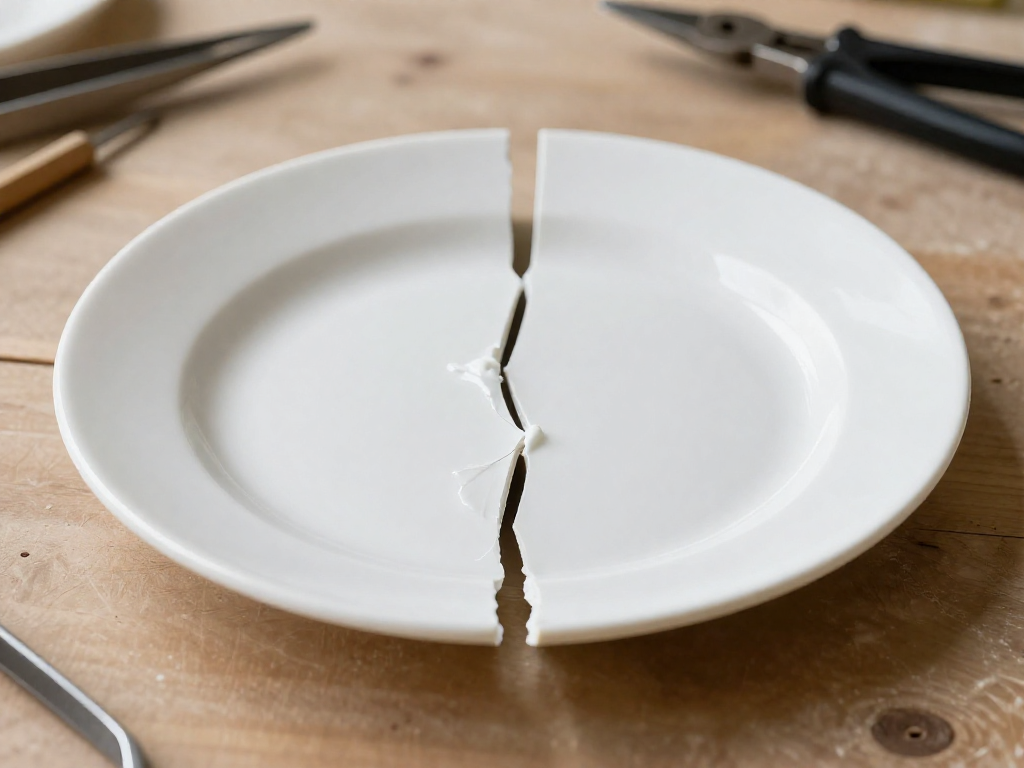
Most DIYers reach for super glue only to watch it fail. We bust the biggest myths about cyanoacrylate so you know exactly when it's the right choice—and when it's a disaster waiting to happen.
Introduction: The Super Glue Promise vs. Reality
When a super-glued mug handle snaps off the first time it hits hot coffee, it’s easy to write off cyanoacrylate as overhyped. Yet the same chemistry once lifted a car weighing more than 5 tons with just nine drops (Loctite). The real question isn’t strength — it’s whether your repair demands heat, moisture, or gap-filling durability that most super glues simply don’t have. This article separates the myths from the materials science, so you know exactly when to reach for that little tube and when to leave it in the drawer.
Myth #1: Super Glue Is Indestructible—It Works for Any Repair
It’s an incredible spectacle: in one jaw-dropping stunt, Loctite used just 9 drops of cyanoacrylate to lift a car weighing over 5 tons—a genuine Guinness World Record. That image convinces a lot of people that super glue is unbreakable, but the reality is far more conditional.
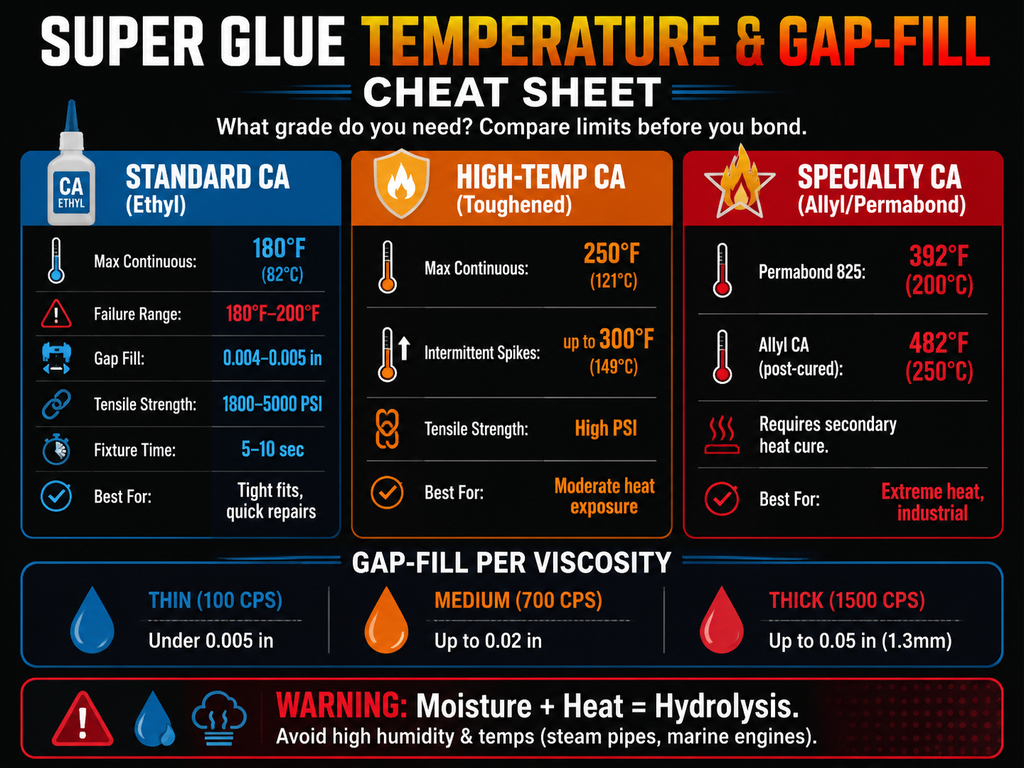
That car lift worked because the bond line was impossibly thin and the surfaces mated perfectly. In your garage or kitchen, any gap thicker than a fraction of a millimeter starts to cripple the joint. Even high-viscosity CA formulations struggle past 0.5 mm, and standard thin glues demand lines under 0.005 inches for top performance. Under ideal tension, a good cyanoacrylate might hit 3000–5000 PSI, but shear strength tells a truer story: on sandblasted steel, Permatex’s super glue reaches only 1800–2400 PSI. Without that aggressive surface prep, expect far less.
What that record fails to show is that cured CA is glass-brittle. It can hold a static pull, but a sharp bump, a twist, or even persistent vibration snaps it instantly. That’s why super glue is a poor choice for anything that will be peeled, pried, or shocked—think chair rungs, car trim, or a mug handle. For those jobs, reach for an epoxy or a polyurethane that absorbs energy rather than shattering. The myth of indestructibility fits between two flat, smooth plates; outside that narrow world, it falls apart.
Myth #2: Super Glue Fills Gaps Like Epoxy
Super glue is not a gap filler—and treating it like one is the quickest way to create a joint that snaps at the lightest load. Unlike epoxy, which cures into a solid mass that bridges considerable voids, cyanoacrylate (CA) demands an almost perfect match between the two surfaces. Its bond line has to be microscopically thin to work. Typical off-the-shelf super glues reliably span a gap of only 0.015 mm to 0.5 mm (roughly 0.0006 to 0.02 inches). If you can see daylight between the parts, you’re already outside that window.
Viscosity is what gives you a little more room, but not much. Thin CA (around 100 CPS) wicks into the tightest cracks but won’t fill anything larger than 0.005 inches. Medium formulas (about 700 CPS) handle up to 0.02 inches while still holding good strength. Thick, gel-type formulations (1500 CPS) can bridge up to 0.05 inches (1.3 mm), according to Gluemasters. That’s the absolute limit for a cyanoacrylate, and it comes with a significant strength penalty. As the bond line thickens, the glue’s own cohesive strength drops off, so a chunky fill is always weaker than a tight, compressed joint.
The classic mistake: grabbing a bottle of thin CA to glue a rough, jagged break. The liquid disappears into the fractured surface, leaving a starved, brittle seam that won’t survive a tug. If the parts can’t be clamped into tight, uniform contact, you’re asking too much of any super glue. For gaps wider than a hairline crack—say, a chipped tile piece or a loose-fitting plastic tab—skip the super glue entirely and reach for a two-part epoxy. Reserve CA for clean, smooth breaks that mate with barely any visible gap. That’s where it genuinely shines.
Myth #3: Super Glue Handles Heat and Cold Without Breaking a Sweat
Most hardware-store super glues start losing their grip somewhere between 180°F and 200°F (82°C–93°C). Permatex’s standard formula, for example, lists an operating range of -65°F to 180°F. That might sound narrow, but things like a dishwasher’s dry cycle, a sun-baked dashboard, or an under-hood bracket near the exhaust can sail past that mark without blinking. Once you cross the threshold, the bond softens and shear strength drops hard.
Heat-resistant formulations exist, but you won’t find them in the impulse-buy bin. Toughened cyanoacrylates rated for 250°F (121°C) continuous service handle engine-bay or radiator-end temperatures, and some tolerate brief spikes approaching 300°F. At the far edge, allyl cyanoacrylates—specialty products that need a secondary heat cure—can survive 482°F (250°C). Those are industrial adhesives, not something you squeegee on a cracked mug. For most DIY repairs, if the part will see sustained heat above 200°F, super glue isn’t your answer.
There’s a hidden gotcha that finishes many a “heat-resistant” CA repair: hydrolysis. Super glue cures by reacting with moisture, but heat and dampness together reverse the chemistry—water attacks the polymer backbone and chops the chains apart (INCURE INC.). That’s why a bond that holds fine in a hot, dry engine bay often crumbles on a steam pipe or an outdoor marine fitting. Humidity plus heat equals early failure. On the flip side, cold alone isn’t a threat to a fully cured bond—the glue stays brittle but intact well below zero. The real cold-weather nuisance is that low temperatures slow the cure because cold air carries less moisture, so you’ll wait much longer for the initial grab to happen.
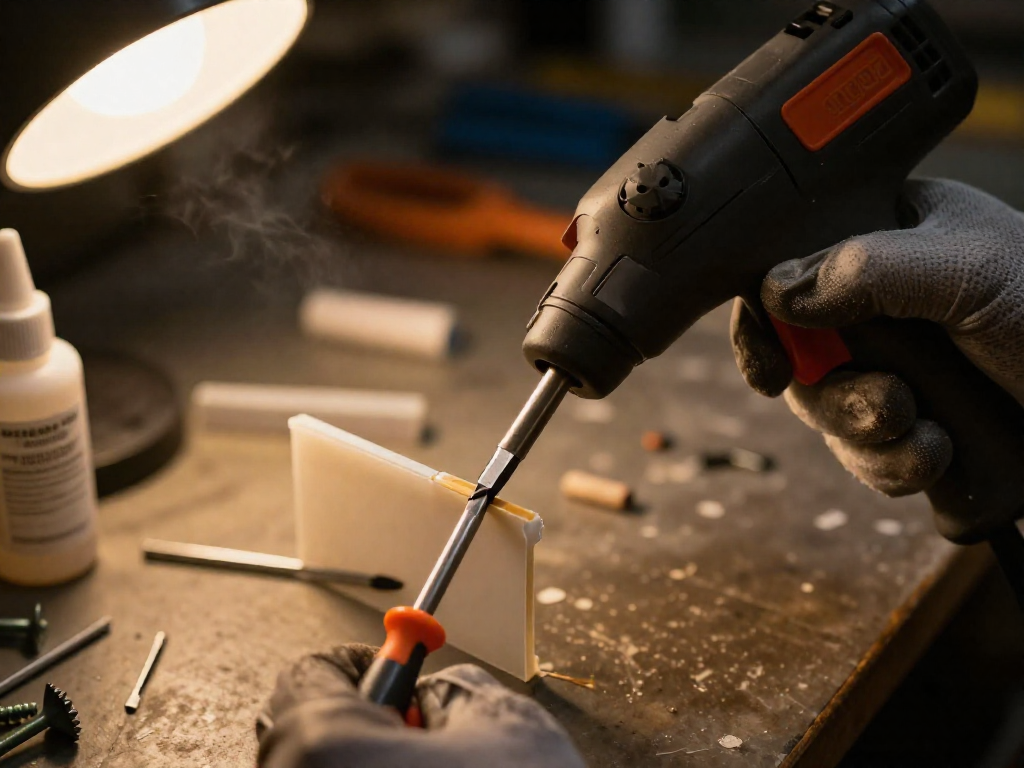
One silver lining: heat can also be your friend. If you need to undo a super glue joint, aim a heat gun at about 200°F, and the adhesive will often soften enough to pry apart without destroying the pieces.
Bottom line: treat super glue as a cool- to warm-service adhesive. When the job will see sustained heat north of 180°F, reach for a high-temperature CA only if you’ve checked its rating and the joint stays dry. For anything that’s both hot and wet, switch to a two-part epoxy or high-temperature silicone—that’s where super glue bows out gracefully.
The Surprising Sweet Spots: Where Super Glue Outperforms Everything Else
Super glue isn't a universal fix—but in its comfort zone, nothing beats it for speed and simplicity. The ideal candidate: two small, rigid parts that mate perfectly flush with zero gap. Think snapped ceramic handle, two clean metal faces, a hard plastic trim piece that cracked cleanly. For those jobs, cyanoacrylate (CA) is untouchable. On aluminum, fixture times clock in at just 5-10 seconds—blink and it's already grabbing. On smooth, non-porous materials like glass or polished steel, the bond forms so fast you have to be ready to align instantly.
The catch? Not all plastics are created equal. Polypropylene, polyethylene, and PTFE (Teflon) are famously slick, and standard super glue will just bead up and refuse to grab. That's where a dedicated plastic primer steps in. As LePage's bonding guide explains, when you're up against the likes of polypropylene, a two-step system—primer/activator first, then glue—is the only reliable path. Apply the primer, wait 60 seconds, add your CA, and you'll get a bond that otherwise would be impossible. No mixing, no mess.
And yes, you'll have that instant tack, but don't confuse "set" with "cured." While a super glue joint is strong enough to handle within about 10 minutes, it won't reach full chemical resistance and ultimate strength until 24 hours later. So if you're fixing a coffee mug handle, give it a day before pouring boiling water into it.
Smart CA Selection: Matching the Glue to the Job
Before you grab a tube, check three things. If your repair will see heat above 180°F, skip standard super glue—it softens around 180–200°F (INCURE INC.)—or reach for a high-temp grade rated to 250°F. Next, match viscosity to the gap: thin CA wicks into tight cracks (under 0.005 inches), while thick fills slightly bigger voids. Finally, stubborn plastics like polyethylene often need an activator/primer to bond. And don’t use CA outdoors or around constant moisture; heat and water quickly break down the bond.
Conclusion: The Super Glue Reality Check
Before you reach for super glue, ask three things: Is the gap nearly invisible? Will the joint stay dry and cool? Will it avoid peeling or impact? If not, skip it—cyanoacrylate is a brittle specialist, not a universal fix.
Sources
- What Temp Does Super Glue Fail? - INCURE INC. — incurelab.com
- Cyanoacrylate Glue's High and Low Temperature Resistance Explained - INCURE INC. — incurelab.com
- High Temperature Resistant Cyanoacrylate Adhesives — permabond.com
- Effects of Low Temperatures on Cyanoacrylate Adhesives | Cyanotec — cyanotec.com
- Technical Data Sheet Permatex Super Glue — permatex.com
- Do adhesives have a minimum thickness (bond line) to be useful? - Engineering Stack Exchange — engineering.stackexchange.com
- Understanding CA Glue Viscosity: Thin vs Medium vs Thick Explained — Gluemasters — gluemasters.com
- Super glue: Everything you need to know — loctiteproducts.com
- How to glue plastic to metal: a professional guide — lepage.ca
See also
- Best Glue for Plastic to Metal
- Epoxy vs. Super Glue: When Strength Matters
- How to Remove Super Glue from Skin and Surfaces
Related articles
UV-Cure Adhesives (Liquid Optical Clear Adhesives): Perfect for Glass and Electronics
What is UV glue, and when should I use it instead of regular super glue?
Jul 22, 2026 · 5 min read
Contact Cement: The Secret to Laminate, Leather, and Shoe Repairs
How do I use contact cement correctly to avoid bubbles and weak bonds?
Jul 22, 2026 · 5 min read
Structural Adhesives: Understanding MMA and Acrylics for Load-Bearing Metal Bonds
What are structural adhesives, and when do I need them over regular glue?
Jul 22, 2026 · 10 min read