Gluing Plastic to Plastic: The Ultimate Guide to Solvent Welding vs Adhesives
Should I use solvent welding or adhesive for bonding two plastic parts?
On this page
Two plastic parts in your hand, and you need them to become one. The wrong choice—glue when you should weld, weld when you should glue—leads to a joint that fails. This guide cuts through the confusion, comparing solvent welding and adhesive bonding side-by-side so you can pick the right method for your plastic, your conditions, and your expectations.
Plastic-to-Plastic Bonding: More than Just Glue
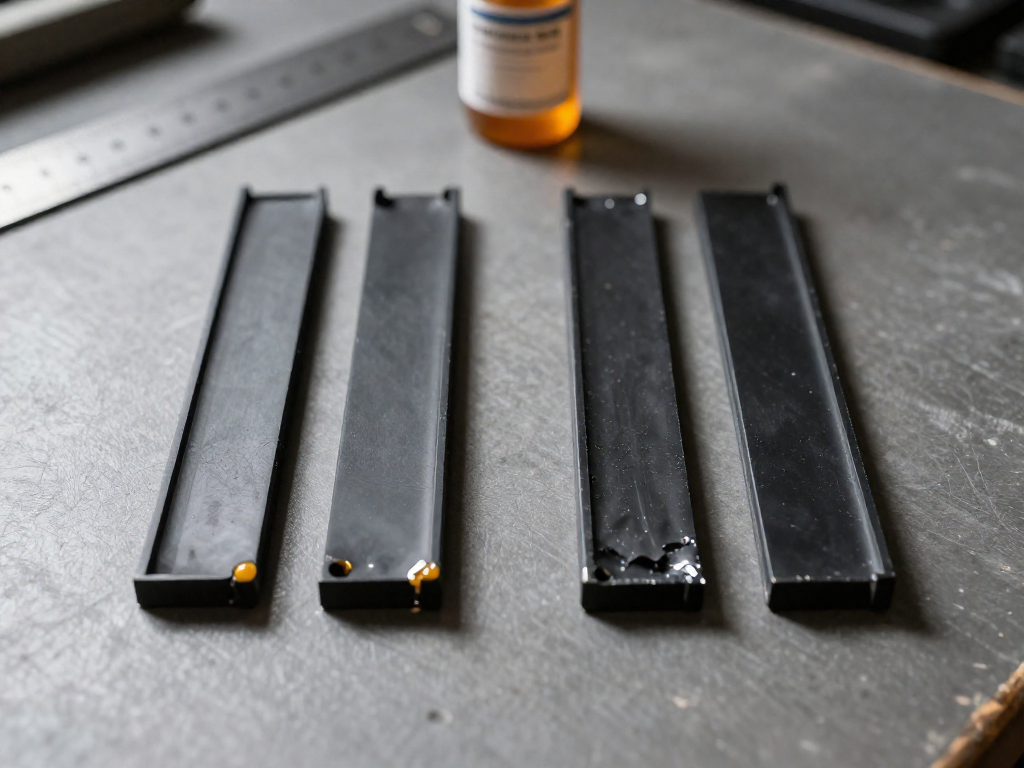
When you’re trying to join two pieces of plastic, the obvious move is to reach for glue. But with plastics, “glue” can mean two completely different ideas—and using the wrong one can send your part right back apart. Solvent welding and adhesives work on fundamentally different principles, and the outcome depends entirely on which plastic you’re holding and what you expect the joint to survive.
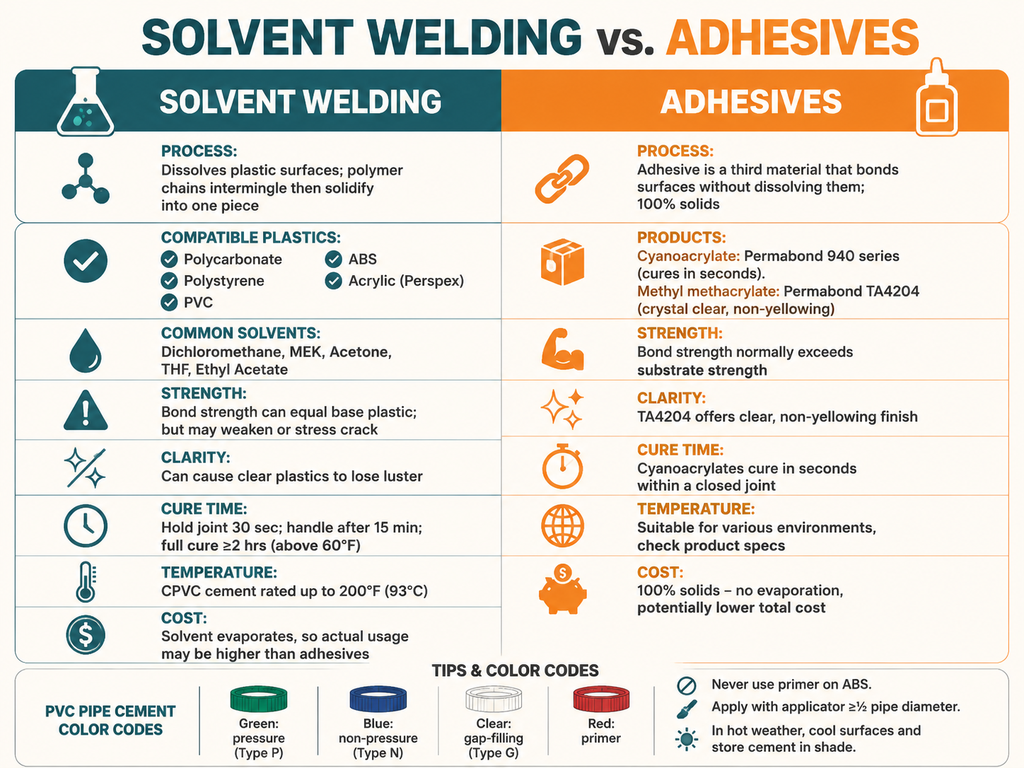
In solvent welding, a chemical (often dichloromethane or MEK) temporarily dissolves the surface, letting polymer chains from both pieces mingle. As the solvent evaporates, those chains entangle and lock together into a single solid mass. This isn’t a surface bond glued on top—as Oatey explains, solvent cement isn’t glue; it chemically softens and fuses the plastic into a permanent joint. Done right, the weld often ends up stronger than the plastic around it. But the trick is it only works on compatible thermoplastics like acrylic, PVC, ABS, polystyrene, and polycarbonate. If you’ve got a mystery plastic or two different types, the solvent will likely just eat one and ignore the other.
Adhesives stick by grabbing onto the surface without dissolving it. They can bridge dissimilar materials and fill gaps, but the bond is only as tough as the adhesive’s own grip and flexibility—no molecular mingling. Choose adhesive when you need to join a plastic that resists solvents (think nylon or polypropylene) or when the joint must handle shock, vibration, or heat that would crack a brittle solvent weld.
Before you open a tube, ID your plastic. If both parts are the same, solvent-weldable type and you need the strongest, most invisible connection, solvent welding wins. If you’re pairing different plastics or the joint will take a beating, a structural adhesive is your better bet. The next sections walk you through making that call with confidence.
What Solvent Welding Really Is (And Why It’s Not Glue)
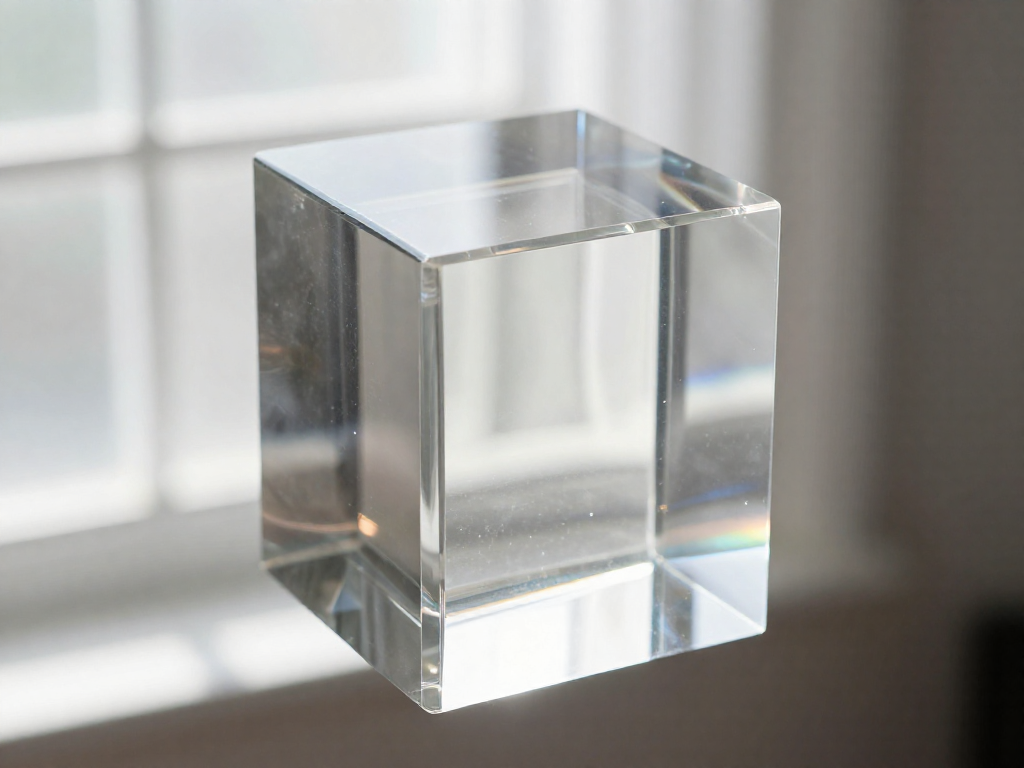
Solvent cement is not glue — it chemically softens and fuses compatible plastics into a single piece (Oatey). Where glue sits between two surfaces, solvent welding actually merges them by temporarily breaking down the plastic surface at a molecular level.
Here’s how it works. A solvent like methylene chloride (dichloromethane) or MEK is applied to the joint. It dissolves the surface of the plastic, freeing the polymer chains to move. When two pieces are pressed together, those chains intermingle. As the solvent evaporates, the chains lose mobility and solidify into a single, entangled mass. There’s no adhesive film left behind — the joint is the same material as the rest of the part.
Not every plastic can be solvent welded. The process only works with amorphous thermoplastics: ABS, PVC, acrylic (PMMA), polycarbonate, and polystyrene are all fair game. Polyethylene and polypropylene won’t weld this way — put down the MEK. The right solvent depends on the material. MEK bonds ABS and acrylic reliably, while polycarbonate and acrylic often call for dichloromethane. For polystyrene, acetone and toluene are common choices.
Solvent cements sold in hardware stores aren’t adhesives in a tube; they’re thickened solvents designed to fill gaps and stay put during assembly. They still weld — they don’t just stick. In hot weather, cooling the joint surfaces with a damp rag (then drying) before applying cement can stop the solvent from evaporating too early, a pro trick straight from industrial solvent-welding guides.
Done right, the joint can match the strength of the original plastic — it’s why plumbing codes allow solvent-welded PVC and ABS for pressurized water lines. The catch? Solvent welding only works once on a joint, and these chemicals need serious ventilation. But for a permanent, invisible, load‑bearing bond, it’s not glue — it’s a material merger.
The Hidden Dangers of Solvent Welding
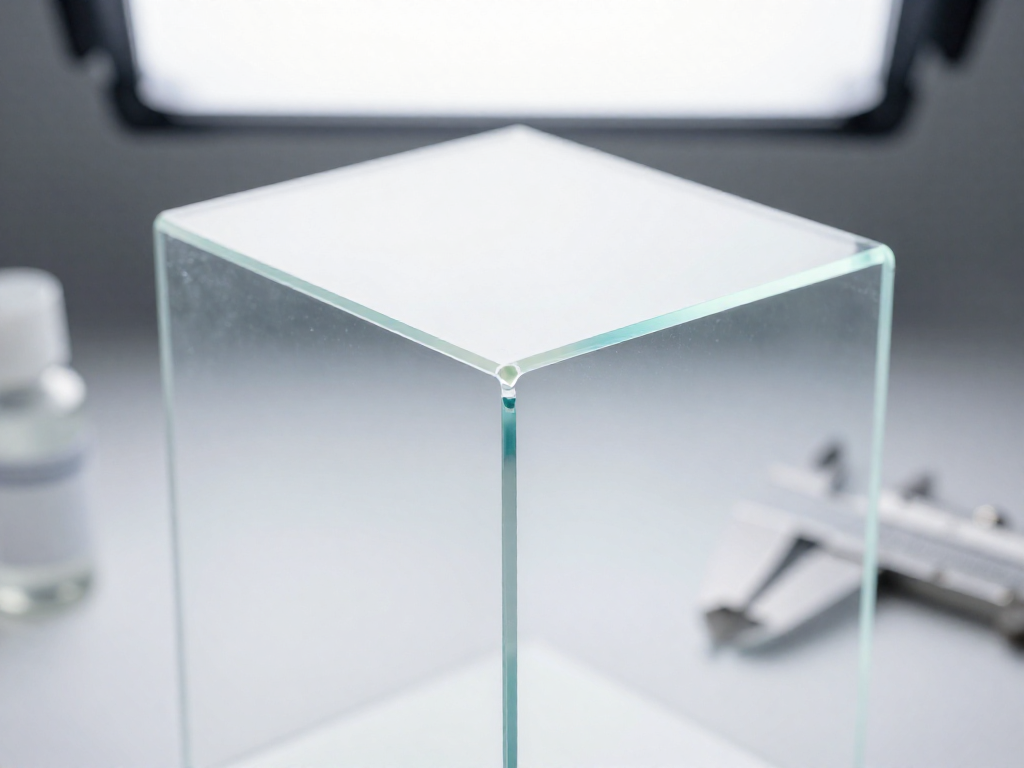
Solvent welding isn't a one-size-fits-all fix, and it can backfire if you're not careful. The aggressive solvents—often based on methylene chloride—don't just dissolve the surface; as Permabond warns, they can weaken, deform, or stress-crack the plastic, and clear parts often lose their transparency permanently. That cosmetic damage might be a dealbreaker for a display case or polycarbonate lens.
Even more critical: this method only works on a handful of plastics. Polycarbonate, polystyrene, PVC, ABS, and acrylic are the standard candidates. If you're trying to bond polyethylene or polypropylene, solvent welding simply won't work—the solvent has no effect on these waxy, chemically resistant polymers.
Finally, respect the chemical hazard. Methylene chloride is a volatile solvent; always work in a well-ventilated space (or outside) and consider a carbon-filter respirator for longer sessions. After applying the cement, hold the joint still for at least 30 seconds and avoid any movement for five minutes—but note that fumes are off-gassing the entire time.
Why Adhesives Often Win for Plastic Bonding
Adhesives sidestep every one of those solvent-welding landmines. They don’t dissolve the surface; they build a mechanical and chemical bridge across it, so your plastic parts stay intact and look like they did before the repair. In fact, the best of them can create a joint stronger than the material itself. Permabond TA4204, a crystal-clear methyl methacrylate adhesive, cures to a non-yellowing finish and its bond strength typically exceeds the strength of the substrate. That’s the kind of headroom you want for load-bearing parts or outdoor gear.
Different adhesives shine in different scenarios. If you need a fast fix and the joint won’t see heavy stress or moisture, cyanoacrylate (super glue) cures in seconds and holds well on small, well-mated surfaces. For gaps, mixed materials, and real structural staying power, two-part epoxies and methyl methacrylates are the heavy hitters. They fill irregularities that solvent welding can’t touch—rough edges, slight misfits, or joints between dissimilar plastics. Unlike solvents, which can weaken, craze, or cloud a clear part, adhesives pose no risk of chemical attack. They stick to what you’ve got without eating into it.
There’s also a practical, cost-side advantage: adhesives are 100% solids. Nothing evaporates, so you aren’t paying for a carrier that simply vanishes. With solvent cements, a portion of the product literally evaporates away, driving up the actual material cost per bond. Over a bunch of projects, that waste adds up. And while solvent welding demands careful timing, perfect fit, and immobile holding, many adhesives give you workable open time and cure on your schedule—no nerve-wracking 30-second assembly windows where a tiny shift wrecks the joint.
When you weigh the risk of damaging the plastic, the ability to bridge gaps, and the raw bond strength, adhesives come out ahead in the majority of home and shop repairs. Unless you have a perfectly matched solvent-weldable pair and pristine mating surfaces, an adhesive is the smarter, safer bet.
At-a-Glance: Solvent Welding vs. Adhesives
Pick your path in seconds:
- Plastic type known and compatible (PVC, ABS, PS, acrylic)? → Solvent weld. It’s the simplest, lowest-cost way to get a bond as strong as the material itself.
- Unknown plastic, mixed types, or need gap-filling? → Adhesive. No chemical-compatibility guessing, and many fill gaps well.
- Crystal-clear finish? Modern methyl methacrylate adhesives like Permabond TA4204 cure crystal clear and won’t yellow (Permabond). Solvent welding can cloud or craze clear plastics.
- Strength? Both methods commonly produce bonds stronger than the plastic—the material fails before the joint.
Solvent Welding Technique: The 30-Second Rule and More
Solvent welding isn’t about brute force — it’s about timing. Start with clean, dry surfaces and apply solvent cement evenly with a brush or dauber. Join the parts immediately and hold them firmly for at least 30 seconds. Don’t disturb the joint for five full minutes, and avoid any stress for at least an hour (Iplex).
Temperature matters more than you might think. In hot weather, cool the surfaces with a damp rag and let them dry before cementing. In cold conditions, the solvent works slower — allow more time and apply extra primer coats to get enough surface softening. Rush any of these steps and the weld won’t reach full strength.
5 Mistakes That Ruin Plastic-to-Plastic Joints
Even the right solvent cement won’t save a joint if you skip these basics. Here are five common errors and how to avoid them.
Mistake 1: Using primer on ABS. ABS solvent welds perfectly without primer; adding it can actually weaken the bond. Stick with an ABS-specific cement and skip the purple stuff.
Mistake 2: Assuming PVC glue works on all plastics. Solvent welding only fuses compatible plastics like PVC, CPVC, ABS, acrylic, and polycarbonate. If you don’t know what you’re holding, you’re shooting in the dark.
Mistake 3: Not identifying the plastic first. Check for recycling codes or manufacturer marks. When it’s impossible to tell, a structural acrylic adhesive like Permabond TA4204 bonds many plastics without needing to know the exact type.
Mistake 4: Moving the joint too soon. After joining, hold the parts motionless for at least 30 seconds, leave undisturbed for five minutes, and avoid rough handling for a full hour. Impatience here causes more leaks than most people realize.
Mistake 5: Using PVC for hot water. PVC pipe and cement aren’t rated for heat and will soften and fail. For hot water lines, switch to CPVC and a cement like Oatey CPVC FlowGuard Gold, which handles up to 200°F without primer.
Sources
- Replace solvent welding techniques with industrial adhesive — permabond.com
- Plastic welding - Wikipedia — en.wikipedia.org
- Solvent & Plastic Welding - Thermoplastic Welding | SealWerks — radiofrequencywelding.com
- How to Execute the 4 Most Common Types of Plastic Welds – IHS | Industrial Heat Sources — ihshotair.com
- SOLVENT CEMENT WELDING OF PVC PIPE — iplex.com.au
- SOLVENT WELD — jmeagle.com
- Solvent Cement vs. Glue: What are the Differences? | Oatey — oatey.com
- 6 Steps to Properly Solvent-Weld Plastic Pipe and Fittings — charlottepipe.com
- PVC Glue & Primer (Do's & Don'ts of PVC Solvent Welding) — youtube.com
- GUIDE TO SOLVENT WELDING PVC and CPVC Plastic ... — weldon.com
See also
- Bonding plastic to metal
- How to glue fabric to plastic
- Best adhesives for outdoor plastic repairs
Related articles
Attaching Foam to Wood: Craft vs Structural Applications
How do I glue foam to wood without melting or weakening the foam?
Jul 22, 2026 · 6 min read
Joining Concrete to Wood: The Right Adhesive for Fence Posts and Decks
Which adhesive is best for attaching wood to concrete in outdoor projects?
Jul 22, 2026 · 11 min read
How to Bond Acrylic to Metal: Achieving a Clear, Strong Joint
What's the best adhesive for bonding acrylic (plexiglass) to metal without clouding?
Jul 22, 2026 · 6 min read