Saltwater-Proof Adhesives: Marine-Grade Bonding for Boats and Docks
What adhesives resist saltwater corrosion and constant moisture for marine use?
On this page
When saltwater meets adhesives, most people think corrosion is the killer—but the real threat is water absorption and climate extremes. In this deep dive, we’ll break down which marine-grade adhesives actually hold up, backed by lab tests and real-world data, so you can bond with confidence whether you're sealing a leaky porthole or reinforcing a dock.
Saltwater Is Not the Enemy — Water and Heat Are
For true saltwater durability, match the adhesive chemistry to the job: marine-grade epoxy for rigid, below-waterline bonds that must never fail, and a quality polyurethane sealant like 3M 5200 for flexible, above-waterline sealing—just know that 5200 is permanent; if you might ever dismantle the part, reach for 3M 4200 instead.
It’s easy to picture salt chemically eating away at your glue joint, but the reality is far less dramatic. Saltwater itself has remarkably little chemical impact on adhesives. The real threat is the water molecule. It works its way into the adhesive, causing swelling (plasticization) and eventually snapping polymer chains through hydrolysis. That’s where chemistry separates the winners from the washouts. Epoxy adhesives, with their dense, highly crosslinked structure, absorb far less water than hybrid polymers or silicones, which are inherently more sponge-like. If your bond lives constantly wet, that difference isn’t academic—it’s the line between a decade of service and an early, ugly failure.
Heat and humidity together turn a slow leak into a gusher. In a comparative aging study, one commercial adhesive that held up for at least five years in the temperate UK failed completely after just six months in hot, humid China—a ten-times acceleration (Forgeway). That kind of cliff-edge failure catches boat owners off guard because the adhesive looks fine right up until it doesn’t. Below the waterline, even without direct sunlight, the bond sits in a permanent warm bath, and constant moisture penetration is what triggers adhesion loss and water intrusion. It’s not UV damage or salt crust—it’s the relentless presence of warm water.
So what does this mean for a real repair? For anything that stays submerged, a marine-grade epoxy putty is the safer choice for a rigid structural bond. Its water resistance and adhesive strength far outstrip polyester resin—on a strength-per-weight basis, epoxy with carbon fiber reinforcement actually beats Kevlar for penetration resistance. But stiff isn’t always best. Above the waterline, where decks and gunwales flex and vibrate, a polyurethane sealant that can move with the joint will outlast a brittle epoxy. The trade-off is longevity under the water: polyurethane resists water well but degrades faster than epoxy during long-term saltwater immersion. So save the polyurethane for the topsides, and keep epoxy in the bilge.
None of this works without spotless, abraded surfaces and a disciplined cure time. Always check the manufacturer’s technical data sheet for your specific materials and conditions; if a bond failure would sink the boat or injure someone, bring in a marine surveyor rather than guessing.
Epoxy vs. Polyurethane: The Underwater and Above-Waterline Showdown
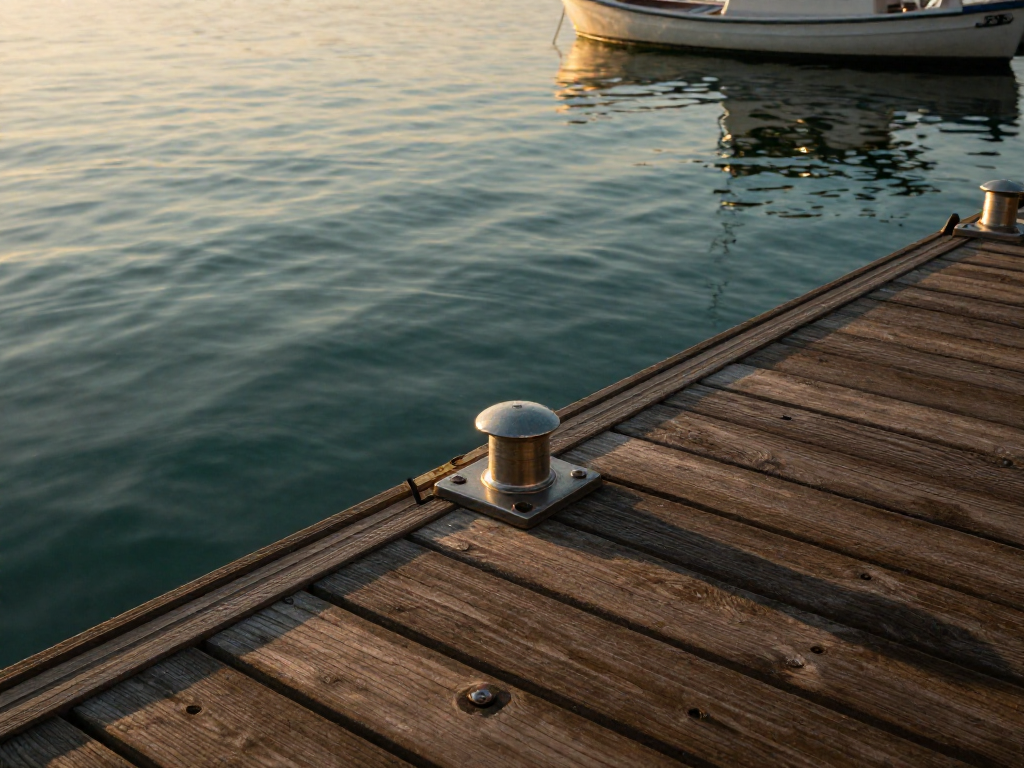
The rule of thumb in marine bonding is straightforward: for permanent structural repairs below the waterline, reach for epoxy; for above-waterline joints that flex and seal, polyurethane is your adhesive. This isn’t a guess—it’s drawn from direct comparison data. ZDS Chemical distills it plainly: epoxy is the clear choice for underwater bonding, while polyurethane excels on deck hardware and topside applications.
Epoxy earns its below-waterline reputation with raw strength. Its adhesive bond is dramatically stronger than polyester resin—a common mistake among DIYers who assume all fiberglass repair products are equal. Polyester resin is cheap and widely available, but it’s meant for laminating, not bonding. For any repair that must hold two materials together under load, epoxy’s molecular grip is leagues ahead. That grip reduces the risk of adhesion loss and water intrusion, the two biggest killers below the waterline. One telling performance metric: a test by Practical Sailor found that epoxy resin reinforced with carbon fiber offered the best penetration resistance of any material tested—on a strength-per-weight basis, it beat even Kevlar. That kind of toughness matters when your hull hits a submerged log.
Polyurethane adhesives—like 3M 5200 and 4200—bring a different skill set. They remain slightly flexible after curing, which makes them perfect for joints that experience vibration, impact, or thermal expansion, such as deck fittings, cleats, and hatches. But polyurethane has a weakness: under long-term saltwater immersion, it degrades faster than epoxy. While it resists water well initially, its durability drops over time when constantly submerged. That doesn’t mean you can’t use it below the waterline at all—3M 5200 is permanently tenacious and often used to seal through-hulls and struts—but it’s there for flexibility and sealing, not for the sheer structural holding power of a rigid epoxy bond. If you need to glue a loose keel or rebuild a fiberglass laminate, stick with epoxy.
A critical nuance: many repair projects fail not because the adhesive was wrong, but because the surface wasn’t ready. For maximum bond strength, scrub surfaces with a 2% trisodium phosphate (TSP) solution to remove grease and mold-release agents, then cure the adhesive at around 70°F and 70% relative humidity. These controlled conditions—used in marine sealant adhesion tests—yield bonds that last. For above-waterline spots that might need future disassembly, opt for 3M 4200, a non-permanent polyurethane that still handles flex and weather. And always remember: it’s the water, not the salt, that does the damage. Proper prep and the right chemistry choice will keep your boat bonded together, whether it’s dockside or underway.
Surface Prep: The Overlooked Step That Makes or Breaks Marine Bonds
Most marine adhesive failures trace back to one thing, and it isn't the glue. Poor surface preparation is the leading cause of premature sealant failure. You can buy the best polyurethane or epoxy on the shelf, but if the surface isn't surgically clean and properly prepped, that bond will peel apart under stress and immersion.
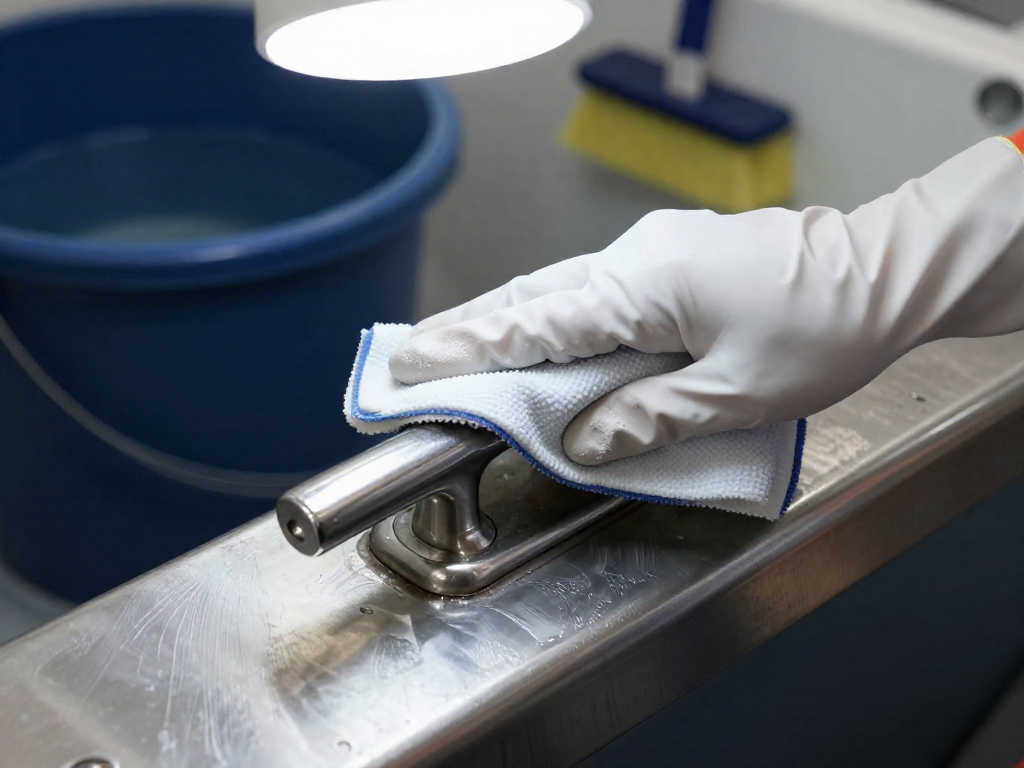
The gold-standard prep method comes straight from the rigorous adhesion tests run by Practical Sailor. They start with a scrub using a 2 percent trisodium phosphate (TSP) solution, which cuts through grease, oil, and the invisible mold-release agents that coat nearly every new fiberglass or composite part. After rinsing and drying thoroughly, the final step is a wipe-down with acetone or denatured alcohol on a clean, lint-free rag. Do this immediately before applying your sealant or epoxy; don’t let the surface sit open and collect dust. According to Practical Sailor, test samples prepared this way and cured at 70°F and 70% relative humidity for eight weeks achieved the kind of adhesion that separates a “good enough” job from a permanent bond.
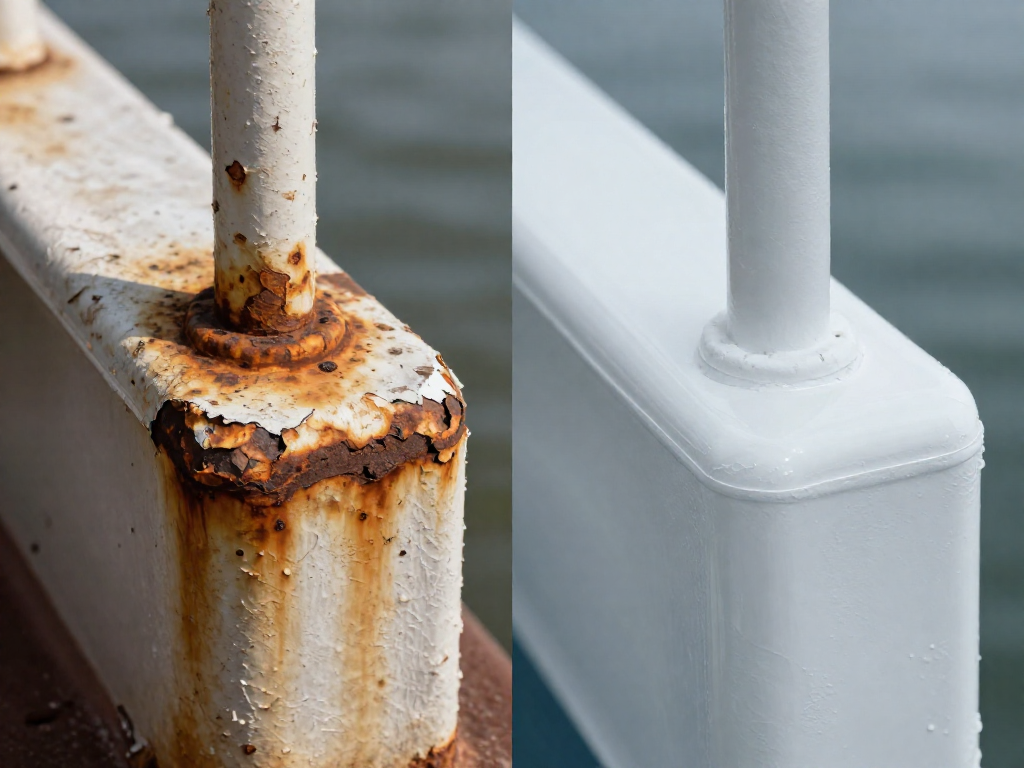
This step alone can push your sealant toward the upper end of its lifespan. High-performance marine sealants are capable of lasting 10 to 20 years outdoors, but that number doesn’t account for shortcuts. When a bond fails after a season or two, it’s almost always because the surface wasn’t free of contaminants. Below the waterline, the stakes are even higher: adhesion loss lets water creep in, leading to progressive delamination and structural trouble. You need the bond to stay waterproof, not just stick.
New parts are especially deceptive. That shiny gelcoat or fresh aluminum extrusion looks clean, but it’s coated with a thin film of mold-release agents left over from manufacturing. These waxes and silicones are designed to prevent adhesion—exactly what you’re trying to achieve. Scrubbing them away with TSP and following up with a solvent wipe isn’t optional; it’s the difference between a seal that lasts a decade and one that fails the first time the hull flexes. Before you pop open that tube of 5200, get the surface prep right. Your boat will thank you.
Marine Adhesive Showdown: Tested Strengths and Weaknesses
If you’re standing in the chandlery aisle staring at 3M, Loctite, and Plexus, here’s the real-world scorecard — no marketing fluff.
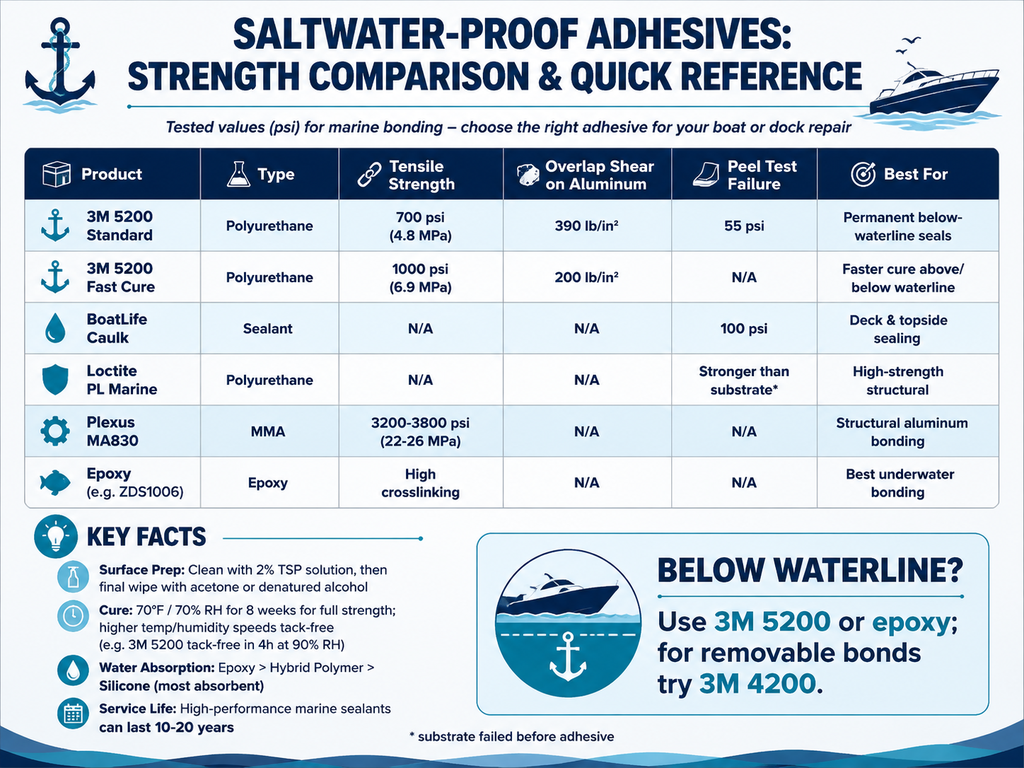
3M 5200 is the permanent polyurethane workhorse. 3M’s own data sheet lists an overlap shear of 390 psi on aluminum, but in adhesion tests by Practical Sailor, it pulled off at just 55 psi — not because the spec is wrong, but because surface prep changes everything. Standard 5200 cures over several days, giving you plenty of open time to position parts, but plan on clamping and waiting. The Fast Cure version cuts that dramatically while keeping the same permanent chemistry: it’s rated at 1,000 psi tensile and 200 psi shear on aluminum, so the speed comes without sacrificing muscle. Just remember both are forever — disassembly means destructive removal.
3M 4200 Fast Cure is the smarter pick when you might need to service that part later. It’s a non-permanent polyurethane that still hangs on tenaciously; in the same Practical Sailor evaluation, it refused to peel and instead tore through the adhesive layer, a sign of excellent adhesion. It’ll seal and bond above or below the waterline without turning your deck fitting into a demolition project.
Loctite PL Marine was the standout in that test: the bond was actually stronger than the test coupon itself, meaning the wood or aluminum broke before the glue line. That’s as good as it gets for a one-part cartridge gun.
BoatLife Caulk is a different animal. It peeled at just 100 psi in those tests, so it’s best left to non-structural sealing — bedding hardware, smoothing fillets, and filling cosmetic gaps — not for holding a cleat in a storm.
Plexus MA830 is a two-part methacrylate that plays in a higher league. ITW Plexus pegs its tensile at 3,200–3,800 psi, and it bonds primerless to aluminum. Fixture time is just 7–9 minutes, and because it cures via a free-radical reaction, humidity won’t slow it down. A note: keep the assembly below 150°F (65°C) during cure, or the reaction can get wonky.
Bottom line: reach for 3M 5200 (or its Fast Cure sibling) for permanent below-waterline bonds where disassembly isn’t on the table. Use 4200 for everything serviceable. When the joint has to be bulletproof right now, Plexus MA830 is the answer. And save the caulk for what it does best — sealing, not load-bearing.
Above or Below the Waterline? Picking the Right Formula for the Job
The first decision is whether your repair lives above or below the waterline, because the demands are completely different. Below the waterline, the big threat is adhesion loss from constant water intrusion, so you need a waterproof, permanent bond. Epoxy adhesives are the gold standard here—their dense crosslinking makes them far less absorbent than polyurethane or silicone, so they resist softening over time. For a below‑waterline sealant that cures into a tough, flexible solid, a permanent polyurethane like 3M 5200 also works, but epoxy wins for straight bonding strength.
Above the waterline, UV exposure and thermal movement dominate. A high‑quality marine polyurethane sealant handles flex and sun far better than brittle epoxies. Here, you also get to choose permanence: 3M 5200 is forever—parts bonded with it often break before the glue does—while 3M 4200 seals and bonds strongly but can be disassembled with tools. Make that call at the start; there’s no undoing a 5200 joint. When applied correctly, top‑tier marine sealants routinely hold for 10 to 20 years, according to Seal‑Bond, which makes picking the right chemistry up front well worth the effort.
Curing Under Deck: How Temperature and Humidity Dictate Your Working Time
The working time on a tube of 3M 5200 collapses from hours to a frantic 15 minutes when the mercury hits 90°F and humidity sits at 90% (3M). Plexus MMA adhesives ignore humidity, but temperatures beyond 150°F can cook them before you’re ready. As a rule, high humidity slashes tack-free time—5200 skins over in 4 hours instead of 12—so get your clamping or fixturing set before you open the cartridge. The standard 8-week lab cure at 70°F and 70% RH is a world away from a hot, sweating bilge, and you’ll need to respect that difference to keep the bond sound.
Sources
- Marine Sealant Adhesion Tests — practical-sailor.com
- Technical Data Sheet - 3M™ Marine Adhesive Sealant 5200 Fast Cure — cdn.mscdirect.com
- Technical Data Sheet — multimedia.3m.com
- Adhesive Guide for Bonding Aluminum in OEM Assembly ... — chemical-concepts.com
- Marine Epoxy vs. Polyurethane Adhesive: 12 Key Differences Every Boat Owner Must Know — zdschemical.com
- A Pro's Guide to Repair Pontoon Boat Problems | Better Boat — betterboat.com
- Epoxy Versus Polyester Resin for Fiberglass Boat Repair Projects - Practical Sailor — practical-sailor.com
- Why Marine Sealants Fail & How to Prevent It — seal-bond.com
- Is Saltwater an Adhesive Killer? What to Consider in a Marine Adhesive - Forgeway Ltd — forgeway.com
See also
- Guide to using epoxy for fiberglass repair
- Surface preparation checklist for structural bonds
- Choosing between sealant and adhesive for outdoor projects
Related articles
Humidity-Tolerant Adhesives: Bonding in Moist Climates Without Blushing
Which adhesives cure properly in very humid environments?
Jul 22, 2026 · 5 min read
DIY Car Repair Adhesives: Fixing Trim, Lights, and Panels That Last
Compare double-sided tape, epoxy, and polyurethane for car trim, panel, and headlight repairs. Data-backed guide with real adhesion strengths and weather durability.
Jul 22, 2026 · 8 min read
Outdoor Fastener Alternatives: When Adhesives Beat Screws for Exterior Projects
In outdoor projects, when should I use adhesive instead of mechanical fasteners?
Jul 22, 2026 · 10 min read